Agents of change: Insights from five grassroots sustainability initiatives
Last year, the Sustainability Accelerator launched a Microgrant scheme, supporting five locally led projects across Africa and Asia. In today's article, we explore insights and challenges that emerged across the five projects, and what they tell us about building a more resilient and inclusive transition.



A tree planting exercise in which E-moti supported NLC to plant over a 1,000 trees. Photo: E-moti team
From September 2024 to March 2025, our Microgrant initiative supported five locally led projects testing new ideas to accelerate sustainable solutions:
- In Nepal, the Mythical Path project retraced a 43-kilometre route said to be travelled by the serpent god Basuki Naag, mapping sacred sites and showing how cultural heritage can guide new approaches to landscape conservation.
- In Sierra Leone, the EcoBrick project turned plastic waste into pavement bricks, training students to transform discarded materials into useful products and creating a simple model for community recycling.
- In Cameroon, the Her Solar Charger project equipped young women with the skills to build solar phone chargers from recycled e-waste, linking renewable energy access with women’s economic empowerment.
- In Nigeria, the GreenBuildAfric project (now Edvolab) transformed plastic and electronic waste into affordable STEM kits, turning discarded items into hands-on learning tools and empowering local young people through practical education.
- Finally, in Kenya, E-Moti's project tested how electric buses, smarter routes, and commuter feedback could make public transport cleaner, faster, and more reliable.
[Delve deeper here] to read more about the specifics of the projects.
Although each project was distinct, here are some of the shared themes that emerged in the challenges they faced and what they reveal about the relationship between people and place.
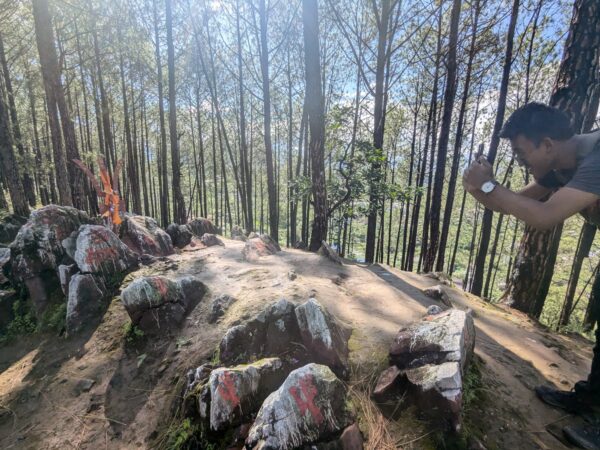
Mythical Path team member taking photos of religious sites. Photo: Mythical Path team
From disruption to innovation
Across the microgrant projects, one pattern stood out clearly: local innovation often takes root in moments of disruption. Some initiatives were born from crisis, while others sought to prevent further degradation or strengthen resilience for what lies ahead.
For instance, in Bamenda, Cameroon, Her Solar Charger’s project emerged amid chronic power shortages caused by political instability. When faced with this energy scarcity, women learnt to build solar chargers from recycled e-waste, becoming active agents in finding solutions for a resource shortage. In Bo, Sierra Leone, EcoBrick’s project arose from an accumulation of plastic waste in streets and waterways. By teaching students to turn discarded materials into pavement bricks, they converted pollution into a resource. Seen side by side, these projects suggest that disruption can act as a catalyst, motivating communities to experiment with new approaches when existing options fall short.
Elsewhere, the Mythical Path project in Nepal was born from concern over a loss of ecological sites in the future, which led them to map sacred landscapes and preserve the cultural knowledge before ecological pressures worsened. This demonstrates how anticipation of future loss can prompt communities to act as decisively as immediate disruption.
These initiatives show how community-led action often emerges in the spaces where systems are strained or slow to respond. Whether prompted by crisis or by anticipation of future risk, each project demonstrates how people adapt by working with the resources around them.
The importance of policy frameworks to support local innovation
If the first lesson was about where innovation begins, the next concerns what allows it to grow. Even the most creative local initiatives can only go so far without the right enabling environment. Across the microgrant projects, many teams confronted structural barriers, from missing recycling systems to outdated regulations that limited how far their ideas could scale. What these stories reveal, however, isn’t just the weight of constraint, but the untapped potential that more responsive policy could unlock.
In Nairobi, E-Moti worked directly with commuters to design cleaner, more efficient public transport routes. Yet, progress was slowed by rigid route-licensing rules and the absence of electric-vehicle charging infrastructure. Rather than a lack of creative solutions, it was the lag in regulation that curbed progress. With more flexible route-licensing policy, projects like E-Moti could become powerful accelerators for low-carbon mobility across cities.
Similarly, GreenBuildAfric aimed to bridge waste-reduction and education, but was held back by the absence of policy incentives for circular manufacturing and environmental education. Introducing modest interventions like tax relief for recycled materials or grants linking waste management with learning outcomes could multiply its reach and influence.
These examples make clear that when local initiatives advance faster than the systems around them, gaps in regulation or infrastructure can quickly become bottlenecks. The task for policymakers, then, is to create space for innovation to adapt and scale. When governments recognise the skills and ingenuity already present in communities and design policy that builds on this existing potential, pilot initiatives gain the footing they need to become durable, system-level change.
The power of social resonance in accelerating change
Beyond the question of policy, the projects also revealed something less structural but equally influential: change is easier to implement when it feels culturally grounded. The projects were most successful when they reflected people’s lived realities, values, identities, and relationship with place.
By retracing the serpent god Basuki Naag’s sacred route and mapping its cultural landmarks, the Mythical Path project transformed myth into a framework for conservation. In doing so, they didn’t just protect ecosystems, they reaffirmed a community’s bond with its landscape, showing that environmental protection can grow from respect for the stories and traditions that tie people to place.
In Nigeria, GreenBuildAfric rooted its environmental education in collective learning and local creativity. By turning discarded electronics into science kits, it connected waste reduction to local values around education, transforming classrooms into spaces of environmental stewardship.
Together, these projects show that sustainability initiatives gains strength when they resonate socially. When people see their own values and histories reflected in environmental action, they are more likely to participate.

School students in a GreenBuildAfric outreach workshop. Photo: GreenBuildAfric team.
The themes of such work echoes many of the broader questions explored in the Accelerator’s Renewal research, particularly how resilience often begins through everyday problem-solving rather than grand plans. These projects offer a clear reminder: local ingenuity frequently lays the first stones of change, creating momentum that broader institutions may later build upon. Environmental resilience doesn’t always grow from redesigning a place to fit an idea, but from recognising the wisdom and worth of what is already there.
Such projects also highlight the power of connecting the local with broader systems of support. They show change can be driven through an interplay of community-led responses to challenges, supportive policy and culturally grounded action. Ultimately, these projects are a good reminder that change often emerges through the connection between people, place and institutions.
