Ghosts of Christmas Future – seasonal sketches from The Fizz
Over the last few months, the Accelerator has partnered with some futurists to develop a tool that creates new possibilities and approaches within futures thinking. In this article we share what we've developed so far with a festive twist - using the tool to explore two Christmases yet to come!


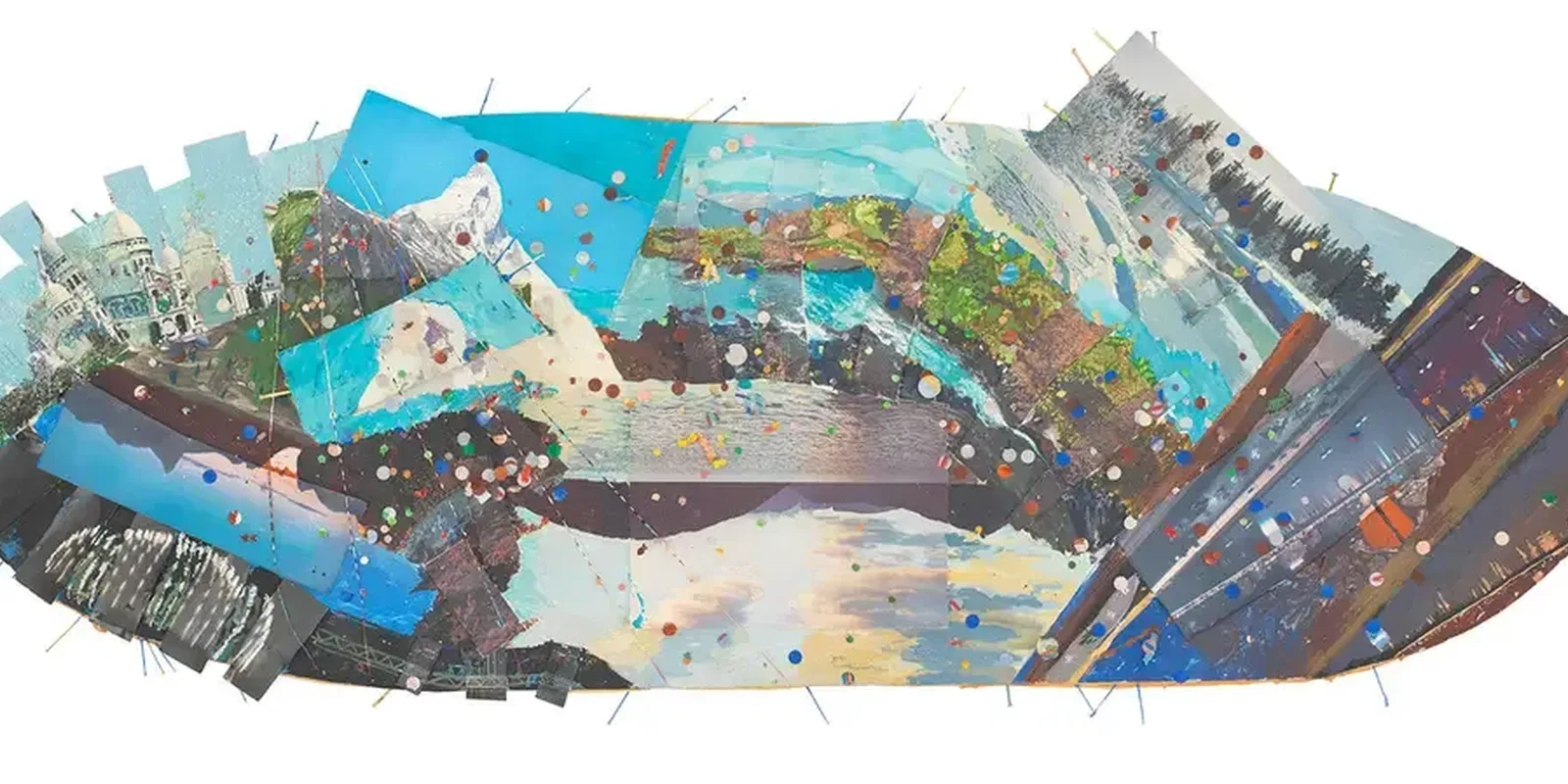
Howardena Pindell, Autobiography: Oval Memory #1, 1980–1981. Mixed media collage on paper, 13 x 32 x 3 inches. Courtesy Garth Greenan, New York.
This year, we’ve been exploring how non-state actors experience something we call The Rift - a period of profound rupture at multiple scales - climatic, social and geopolitical. A key theme throughout this work has been the need for more expansive consideration of how these dynamics might shape our collective future. In short - the need for effective futures thinking has never been greater.
However for many leaders, the traditional tools of strategic futures are not always meeting this moment. As increasing reliance on AI and machine learning combines with productised methodologies, leaders have told us how scenarios projects often lean towards generic sameness. Grounded in similar assumptions, values and data points - and generating bland scenarios that do not reflect the dynamics we need to explore and navigate as institutions and societies.
In this context, the Sustainability Accelerator has been working with David Bent of Atelier of What's Next and Andrew Curry to explore how novel interactions of tech and futures practice might help. A particular focus in these conversations has been the role of AI. We all know that AI and LLMs can used in ways that contribute to a “slop” that impoverishes thinking, but is this always the case? What combinations of human and LLM capabilities might open up different approaches to futures thinking? How can the high-dimensional computation be embedded in human processes to increase our ability to navigate uncertainty and ambiguity?
At the heart of our questioning is how we shift from viewing AI as a form of lean efficiency to one of conceptual and strategic enrichment. The distinction is important. When futures processes are successful in creating change, it is not because they churn out content. It is because they invite people to do the cognitive work of reimagining the world. Successful futures projects are always project of social construction. Starting from this basic premise, we have been exploring how AI might help us achieve this goal. And to do so in this particular moment in history, when many find it hard to overcome the weight of present realities.
One early outcome of this enquiry has been a beta version of something we’re calling The Fizz – an AI-assisted thinking partner to help leaders plan for a wide spectrum of futures. The Fizz scans a variety of data sources to gather, shape and collide seeds of possible futures, and then generates sketches and stories of future worlds, told from the perspective of a range of different voices.
The tool is novel, but we should also note it’s not entirely new. We drew inspiration from a wide range of sources, including key texts such as Ben Vicker's Atlas of Anomalous AI, Arturo Escobar's Designs for the Pluriverse and Ursula LeGuin's the Carrier Bag of Fiction, alongside the design ideas of Seeds of Good Anthropocene by Tanja Hichert, Rika Preiser and Wendy Schultz.
At present, The Fizz generates these sketches as stimulus for pattern analysis and workshop structures. The goal is provocation, not precision – as good futurists will often tell you, the purpose of looking at the future is not to predict, but to disturb the present. Whilst it is still early days for the project, feedback has been encouraging. So buoyed by this enthusiasm, and the twinkling lights of an ever-closer holiday season, we’re signing off the year with a few festive fragments from our current Beta.
Sketch 1
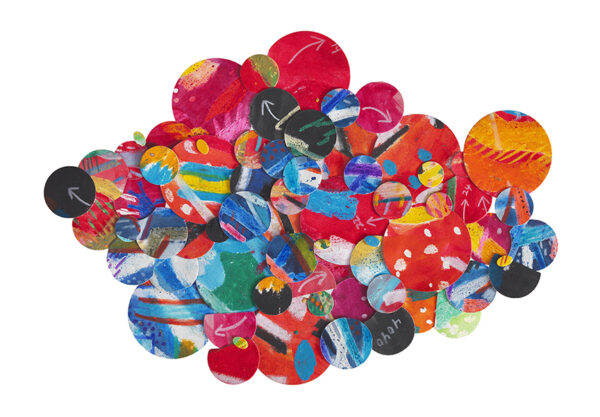
Fragments and seeds of the future - Howardena Pindell: What Remains To Be Seen. Rose Art Museum February 1, 2019 - May 19, 2019.
First up, here's The Fizz exploring a future fragment where climate disruptions from a slowing Atlantic Meridional Current combined with new forms of UK economic and political innovation inspired by the example of North Syria’s Rojava region:
On Oxford Circus, the air crackles with the scent of spruce resin and juniper-bark fires, piped through the city’s geothermal vents to warm plazas year-round. The National Yule Cooperative orchestrates public choirs and Sami throat singers, whose voices echo through glass-domed Christmas party pavilions. Amidst this cold, communities rally in shared warmth, crafting handmade gifts, igniting a new thrift culture that deepens social bonds but leaves retailers struggling.
With a new British landscape that seems to resemble Lapland more than Leeds, The UK’s Snowbound Commerce Act underwrites the “Great Yuletide Circuit,” a supply chain festival linking Britain with cooperatives across the region, exporting solar-grown produce and artisanal goods. The North Sea Ice Rail is key part of this new trade and transport infrastructure, ferrying festive imports to homes everywhere and turning Newcastle into a powerful winter logistics hub.
In supermarkets across the country, new mycoprotein-based mince pies, are the breakout success of the season - but the land use required to development them disrupts local sheep farming, causing rural resentment and sparking lively debate in the King’s annual speech.
Sketch 2
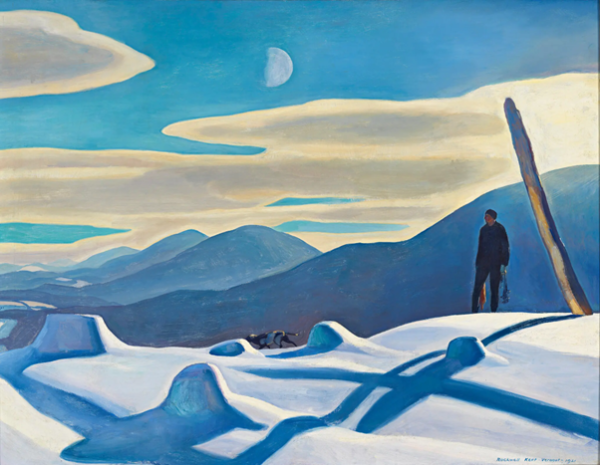
Rockwell Kent’s “The Trapper” (1921) in the collection of the Whitney Museum of American Art in New York. Credit: Rights courtesy of Plattsburgh State Art Museum, State University of New York, USA, Rockwell Kent Collection, Bequest of Sally Kent Gorton. All rights reserved. Photo: © Whitney Museum of Art/Licensed by Scala, via Art Resource, NY. Featured in NYT.
Working with a different set of seeds, The Fizz explored how christmas traditions might evolve in a world where climate change increasingly challenges traditional forms of forestry, and new biomaterials emerge as a credible alternative. The Fizz must have been feeling particularly festive this time, and decided to go full-on Charles Dickens ...
Marley’s old warehouse in Wapping (which had been a warehouse when ships were ships, and now served the new trade in kelp-board, kelp-thread, kelp-things that looked like wood until you put your nose to them) stood that Christmas Eve with the river air gnawing at its corners, and with a little wreath of sea-salt on its latch, as if the Thames had been at it with a wet finger.
Mr. Edwin Pritchard, who kept the invoice-book and kept, likewise, a small hope alive in the same breast: he wanted a tree. Not a tower of a tree, fit to scrape angels off ceilings, but something green enough, and honest enough, to stand in his mother’s room in Stepney and make her say, with that weak laugh of hers, “Why, Edwin!”
The obstacle was not Edwin’s purse alone, but the weather; for the pines up in Perthshire had been baked one season and drowned the next, and the street-stalls, once so bold with needles, now offered thin little sprigs like apologetic brooms.
At a stall beneath the awning of St. George’s Town Hall, a man held up a tree no higher than Edwin’s elbow. Behind the stall, a crate stamped FIRTHFLEX — SEAWEED COMPOSITE held moulded “branches,” dark and glossy, with wire-ribs; and a child stroked one, and found it spring back like a reprimand. Edwin’s eye caught a screen in the Town Hall window, where the King’s face, grave and kind, moved among captions about “hard winters,” and “making do,” and the lamps in the background shone steady as if they meant it.
The use of different authorial voices might seem playful, but there is a serious intent behind them - exploring futures, strategic dilemmas and possible decisions from different perspectives can be a vital part of robust and effective decision-making.
Although still an early prototype, The Fizz is proving an interesting experiment in how AI might work alongside humans in pro-social ways to enrich our understanding of the present and rehearse paths to more sustainable futures. In that pro-social spirit, we’ll sign off 2025 with a profound “thank you” to everyone who has worked with us this year – and with best wishes for the journey ahead.
If you would like to learn more about The Fizz or the Accelerator's work more generally, please get in touch.