Systemic risk, eco-artists, and accessing non-human perspectives
Continuing our series of interviews with leaders in their respective fields of the climate and nature transition, this month we sat down with Phil Tovey, who's working to implement nature-centric approaches into risk assessments.

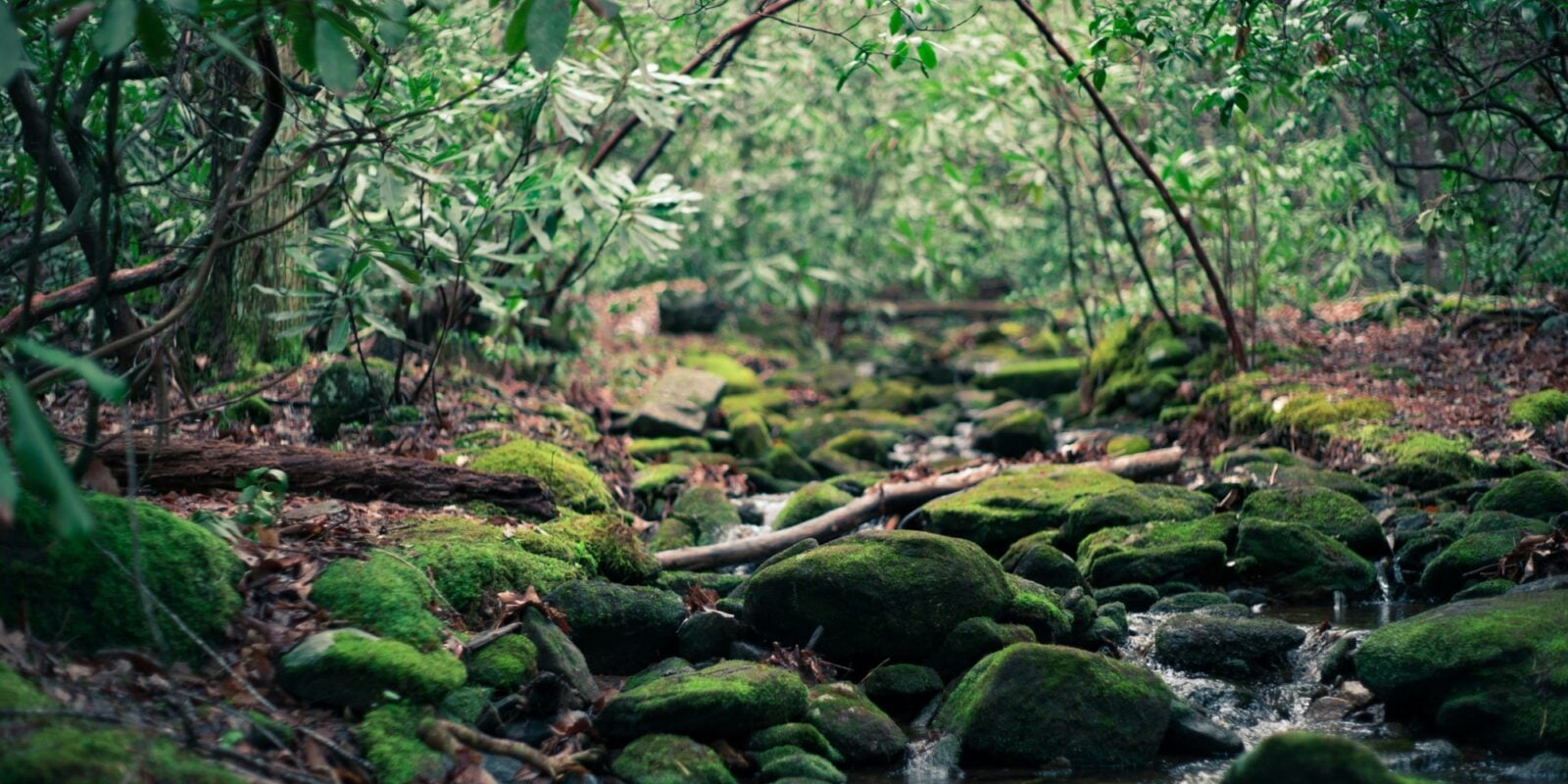
Photo: Mitchell Griest via Unsplash
As part of our research cycle, we are interviewing a range of influential and inspirational leaders from across the climate and nature transition. These interviews are intended as a window into innovative and exciting ways of approaching the transition and to spotlight the people who are at the forefront of these changes. Here, we sit down with Phil Tovey, the Director of Nature-Centric Approaches to Systemic Risk Assessment at ASRA. Phil has a long military career, serving as a Royal Marines Commando with deployments in Northern Ireland, Africa, Afghanistan, and in counterterrorist and information operations. As a Visiting Research Fellow with University of Reading, Phil’s PhD research centres on autoethnographic immersions with River Tone as an augmented human.
What is one object that you currently have on your desk?
My newly arrived DJI goggles N3, which are drying off after their first dusting of Bone White spray paint on top of the browns I carefully painted on by hand the previous day. The base of the lateral antenna forms the burr of the Exmoor roe buck antler which inspires the design. These goggles are for my First-Person-View (FPV) drone, the lightweight DJI Neo, which, in a few weeks' time, will join me on my second initiation with River Tone, Somerset, part of my PhD conducting autoethnographic research into the embodied temporality of the river with augmented senses (I’m calling this immersion: “drone river-warging”!). The preparation of the kit was something first inculcated in me as a Royal Marines Commando, a culture where everyone invested in customizations and personalisations of their gear. From the positioning of your dagger to the hand sworn modification to your combat jacket, these were rituals—not that we called them that. This is all in anticipation of how one's own body will move through the environment with commando-artistry; a symbiosis of muscle, night-vision, rifle, and the land. As I prepare to spend three nights barefoot, stripped down, dry fasted and sodden, journeying at the second source of River Tone, painting my FPV-bone-mask-goggles re-immerses me in my former warrior rituals which I’m starting to realise is also connecting me to something much more ancient, more otherworldly, more animalistic.
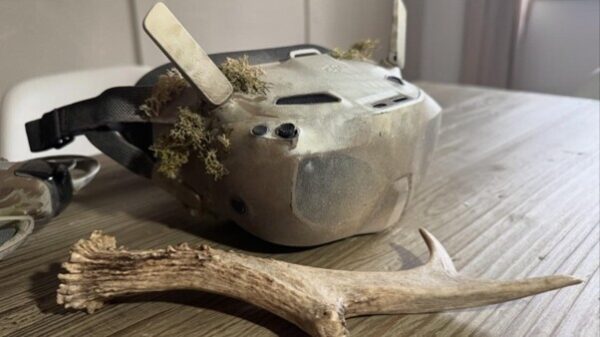
Phil's Goggles, ready for a trip
How would you explain what you work on to a five year old?
[Squats down, and gestures for the child to climb onto his back]. The world you live in, young bear, is different to that experienced by your mum, granddad, great granddad, and all your ancestors going back to the last time these lands were covered with ice, some 11.5 thousand years ago. I work with a small team trying to figure out how to make sure the risks we face today don’t destroy us all. My specific job in the team is to learn from and work with all the animals, plants, fungi, even the mighty mountains, and tiny bacteria. We think they hold the secret to making this world safe and stable again and we need to listen deeply to them; free the ones we humans have enslaved and protect them from future threats to come. How might we do that? It all starts from getting us humans to remember our animal ways again! [jumps around with the child on their back, then wrestles with them; talking is boring!].
Can you describe a recent moment or experience on a project that has particularly stuck in your mind?
In June (2025), we—ASRA (Accelerator for Systemic Risk Assessment, an independent project hosted by the United Nations Foundation)—held the first ever global, transdisciplinary symposium on systemic risk in France. Together with Prof Tom Oliver (University of Reading), we hosted a half day workshop “Rethinking Risk Beyond the Human”. The task for the workshop was to create a vision of a world of reduced systemic risk from a nonhuman perspective. In other words, to create a multispecies vision. The results of the workshop surprised us all. Each person was asked to represent a species. Each species independently wrote their own idealised future—grey fox, dolphin, hawk, even gut microbiome—and then Tom and I fused them together before putting it through RunwayAI text-voice generator. The vision spoken back jumped from the ocean floor to trees to air corridors to solar navigation disruptions. In some ways, the vision didn’t make much sense, but it sounded distinctly nonhuman, more ecological in the way it twisted on itself, more textured and layered with multispecies perspectives. We then spent the afternoon looking at the real-life case study of the increased Russian nuclear war escalation between Oct-Dec 2024 and asked, “how could we assess and respond to the systemic risk of nuclear war if we took a nature-centric approach?”. What stood out for me was that profoundly different thought patterns are possible when we deliberately applied a nature-centric approach. Through our work at ASRA, we’re now following up on this, driving new R&D into systemic risk that draws on these insights, and looks (smells, tastes, vibrating, and pulsing) very different to our more mainstream work.
What are some of the hardest challenges you’re grappling with right now?
Systemic risk itself is a relatively new field and there are many non-trivial complexities, such as calculating transmission rates of risks through a system, quantifying multiple probabilities along the risk chain, or getting reliable early warning of socio-ecological systems collapse.
Through my focus on nature-centric approaches, we’re working to understand, assess, and respond to systemic risk beyond human ways of knowing. What happens when you approach these challenges, for example, with no neocortex, through thermal or chemical profiles, with heart rates of 800 to 1,200 beats per minute (bpm), or lifespans over 400 years? For example, systemic risks to food systems look very different if you’re a swift, Colorado beetle, or jaguar.
Human-centredness is so structurally and systematically internalised in modernity it can sometimes feel unfathomable to think outside of the associated paradigms, but there are ways to do it. One way, of course, is by listening to Indigenous communities who have never lost their connection to the land, sea, and the air itself, and we’re privileged that the SIRGE coalition is an ASRA member to help here.
Disrupting centuries of embedded thinking is a massive challenge. Yet, accessing nonhuman sensory ecologies is within reach and, with some creative and imaginative thinking, can be operationalised.
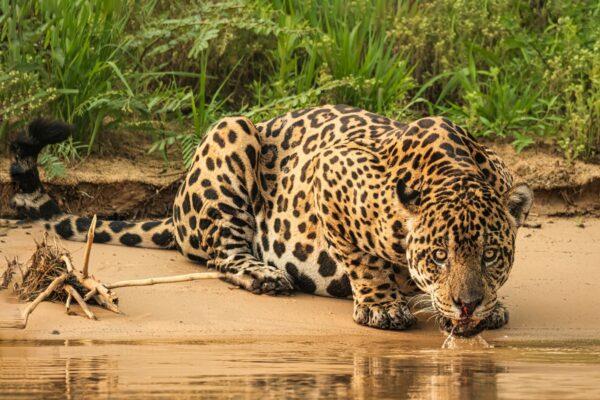
A jaguar drinking water in Brazil. Photo: Joanne de Graaff via Unsplash.
And what are the most exciting developments you are seeing in your space?
There’s a lot to say here.
Firstly, I’m inspired by those that purposefully explore (and endure) the embodied physicality, porosity, and absurdity of contemporary living, such as artists such as Marcus Coates, Thomas Thwaites, Miranda Whall, and philosopher-academic Charles Foster. In simple yet profound ways, through long exposures to weather, goats, soil, or cold water, etc., they highlight the real absurdities (or decadence) of modernity, such as how idealised (and aspirational) levels of comfort are such strong driving forces for social policy and technological innovations. For nature-centric systemic risk assessment and response, these artists help us build an understanding of “the system” in a nonhuman way. As Marcus Coates recently said, “subjectively, there are huge degrees to which I can explore the sameness of the goshawk” as opposed to our differences.
Eco-artists such as Fiona MacDonald (Feral Practice), Anne-Marie Culbone, Josh Cohen, and James Aldridge, take their ecologically-focused work into eco-centred community engagements that are also pivotal in catalysing ground- (or water-) up movements. To me, this is the nourishment for the systems transformation we need. I’m also inspired by the movement of radical institutionally-focused activities that inject nature-centricity into the mainstream, such as Moral Imaginations leading the first response to a UK government policy consultation by way of an Interspecies Council, or the upswell of legal reforms through Rights of Nature. The next big thing we need here is nonhuman decision support systems; imagine the analytical, intelligence and planning capabilities of a military command centre in a time of war, designed to support multispecies liberation.
The most exciting developments for me all broadly share a form of ecofeminist, queer, posthumanist, speculative and new ecological realist foundation (e.g., multigenre Symbiopunk Audax Gawler, performance artist Mária Júdová and the entire work of the RCA superFUTURES platform under Gem Barton, and research from the Centre for Sociodigital Futures). This type of work creates the liminal spaces - those that define any fixed form or definition - that I see as necessary for transformation.
This then creates a bridgehead for the more scientific and technical advances that are pushing frontiers in the nonhuman space, to enter. The Interspecies Internet, who, among many other things, are developing innovative open-source approaches to wildlife data collection and developing modular, multispecies technologies for logging audio, movement, and environmental data. And I’m really looking forward to seeing what Ilyena Hirskyj-Douglas’ major new project "FUTUREFAUNA: Reshaping the Future of Animal-Computer Interaction through a Framework for Animal User Needs and Agency” produces. This comes alongside revolutionary research of Andy Adamatzky and team at the UWE unconventional computing lab which is demonstrating that slime moulds and fungi can compete with semiconductors.
Now, imagine what happens when all of the above start to converge?
You’re organising a gathering to discuss new approaches in the transition to a sustainable future. What does it look like, what would it focus on, and who would be around the table?
Table? There’s no table here. We’re crouched in the ferns, wrapped in the temperate rainforest mist and river-babble, flanked by Atlantic oaks, our bare feet appreciating the softness of the mossy understory and the rocky overhang to perch and rest. We haven’t eaten for days and our geomagnetic senses are heightened; we track further upstream to the moorland to find deer. Golden eagle has killed, and at the same time we pick up traces of metallic on our tongues Common Buzzard mews overhead to confirm. With the other kleptoparasites, we dine tonight, together, by open fire. Maybe wolf will join us in the Old Way, through eyes wrapped in forest-shadow. We’ll recce the next stone circle we can rebuild for community fires, with seven sites from the mouth of river now established, we need five more for her full body to be rewarmed. We will drum, and drum, and drum. We’ll consult River and further strategize on how to advance our legal non-reformist-reforms on their personhood whilst getting back-briefed from wigeon, on return from their 4000 km eastern migration, on the nuclear threat. After 10 days with River, each of us will disperse, back into our institutions, carrying the spirit and smells of wild futures-in-the-making.
To find out more about Phil's work, check out ASRA here

