Notes from the Rift: Rethinking Action in a Changing World
Over the course of the last six months we've learnt a lot. In our final microsite article of 2025 we reflect on some key takeaways, including emerging dynamics and preliminary hypotheses.


The Rift. Image: Eva Oosterlaken
There’s a good claim to be made that 2025 has been the year that “collapse risk” went mainstream. Of course, worrying about end times is a familiar characteristic in all societies. In the context of climate, it’s been around for decades – from the World3 model in Limits to Growth, influential papers on Deep Adaptation, and a slew of efforts by scientist to capture existential risk via frameworks like Planetary Boundaries.
But 2025 felt different. This may be partly due to the increasingly common, dramatic events like the LA wildfires and Bolivian floods – underlining how climate shock can hit anyone, anywhere. Perhaps more importantly, this year the risks of climate-induced collapse increasingly being discussed in places that have been traditionally averse to these kinds of topics.
Within financial communities, we’ve seen increasingly vocal concern about how climate risks are not adequately factored into current planning, causing a range of economic and transition risks. Examples of such broad and rigorous research has been accompanied by an extraordinary set of statements by business and governmental leaders – with the Icelandic Government’s Minister for Environment, Energy, and Climate, Jóhann Páll Jóhannsson publicly recognising the security risks of AMOC (the Atlantic Meridional Overturning Circulation), and Allianz’ Gunther Thallinger underscoring how climate-induced shocks to the insurance industry have the potential to freeze the global economy.
We have also seen growing efforts to mainstream conversations around climate-induced collapse risk, including the widespread exposure of Luke Kemp’s Goliath and the runaway success of Overshoot, a podcast exploring the contours of a post 1.5 world by one of the Sustainability Accelerator’s Associate Fellows, Laurie Laybourne. By the time last month’s UK National Emergency Briefing came around it, didn’t just feel necessary, but inevitable.
It’s worth noting that this year had much to celebrate too – including renewables outpacing coal as the world's primary source for electricity for the first time. But something is clearly going here – not just in the underlying climate science, but in how increasingly broad cross-sections of society are reckoning with extreme climate risk. What does it mean for global citizens, business and governments? And how do these changes alter the opportunities and challenges for those of us trying to accelerate the transition to more sustainable futures?
Awareness ≠ Action
Perhaps the most obvious point to make is that although awareness of climate risk might be rising, that does not always correlate to increased action. This has been well-evidenced for years, but it remains a common misconception. And it's something that is true at both individual and institutional levels – although finance communities may be generating increasingly sophisticated understanding of climate risk, this may actually act as a disincentive to climate finance - largely due to the ways in which material climate risks fall outside of the incentive structures and timescales of commercial investment. Similarly, within the insurance industry, there is increasing discussion around how defensive responses to climate shock (via tactical repricing, market exit, etc.) will only increase the long-term vulnerability of the sector and the societies they serve.
These are knotty issues that several of the Accelerator's initiatives address in different ways. Initially incubated with the Accelerator, the Strategic Climate Risks Initiative have been very active in raising awareness of potential derailment risks and how policy innovation can protect key transition pathway. Another project incubated by the Sustainability Accelerator is taking a systems thinking approach, analysing the structural causes and solutions to this kind of short-termism within the finance and investment system. Varied in scope and approach, both projects highlight ways in which careful coalition-building and framings are key to translate heightened awareness of climate risk into effective action.

Overshoot podcast. Produced by Planet B Productions in partnership with the Strategic Climate Risks Initiative.
Changing the equation
Whilst we can celebrate areas of progress, it’s important to acknowledge that we are already beyond “business as usual” scenarios. Our new climate reality is already quietly eroding many of the foundations of our global economy and reshaping the terrain which our transition plans will have to navigate.
It's easy for such discussions to remain in the abstract, so for much of the rest of this article, we will focus on decision-making around energy transition as an illustrative example. It's an important topic, and at a number of important inflection points. Alongside an astounding growth in renewables, this year has also seen growing momentum behind the argument for nuclear. To date, nuclear has been an unusually expensive energy source – with high capital outlay and decommissioning costs. Nuclear projects also contain unusually high levels of uncertainty, delay and project cancellation - alongside vulnerabilities to debt financing, supply chain shocks and inflationary pressures, and exacting regulatory requirements. Experiencing many of these dynamics, the costs of UK’s Hinckley Point have grown from 16bn in 2016 to almost 46bn this year.
In the context of this article, we note that although nuclear energy might make sense to some in a stable climatic and macro-economic environments, this rationale may rapidly break down if the underlying assumptions change. The nuclear industry remains optimistic, with the IEAE increasing its projections for nuclear power for the fifth year running, but with the caveat "The assumption that current market, technology and resource trends continue and that there are few changes in laws, policies and regulations affecting nuclear power". Which is quite a caveat, given that current market and resource trends will most certainly be reshaped dramatically by climate in coming years – with climate change driving dramatic reductions in global GDP – with several estimates increasingly pointing towards 50% by end of century. As climate realities exceed the baseline assumptions of many IAMS models, nuclear safety mechanisms will also by challenged by increasingly extreme weather events and unanticipated climate effects (including but not limited to jellyfish). Such developments will further complicate the benefits for citizens and the broader environment.
With a widened exposure to systemic risk, the extraordinary cost, long timelines and infrastructure “lock in” of nuclear energy might be seen in a very different light. We might ask whether governments will be in a position to continue to invest to realise such infrastructure in the coming years. Taking a longer perspective, we might also reflect on the ways in which future generations will be locked into both capital intensive energy generation and capital intensive waste management when future societies and governments are likely to have dramatically eroded financial and operational capabilities.
Our point here is not to advocate for specific energy plans, but to highlight what happens when we consider future plans in anything other than a "business as usual" scenario. Current transition planning is often careful to to factor in first-order impacts of climate change like changing sea levels, but often does not engage sufficiently with the second-order impacts to broader societal, economic and governance structures, and is therefore extremely vulnerable to these kinds of issues.
In a world of heightened climate risk, we need to ensure growing awareness of climate risk is not only harnessed to accelerate the transition, but also to re-evaluate which pathways are likely to be most effective in a rapidly changing world.
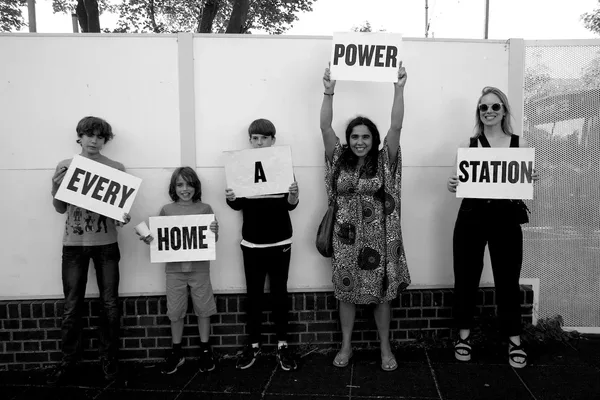
POWER STATION by Hilary Powell.
Taking decisions differently
Experts in decision-science talk about this as a shift to “robust decision-making” – taking decisions based not on our “preferred best case”, but on the plans that deliver in the broadest range of possible futures. For example, which plans thrive equally well in scenarios where the Sub Polar Gyre collapses and scenarios where it doesn’t? In futures where global collaboration is effective or disruptive?
To state things simply: we’re moving into a world with a far greater range of possible futures (climatic, economic, social), and a significantly reduced ability to predict which of those might come to pass. In this world, not only our plans but our approach to decision-making needs to shift too. We can no longer rely on prediction in a world which is fundamentally becoming more unpredictable.
In the case of energy, this would mean shifting emphasis away from plans that deliver an ideal energy mix. Instead we'd explore what system guarantees basic energy provision in the widest range of climatic, economic and geopolitical futures. While more detail is beyond the scope of this article, the defining characteristics of distributed renewables (low cost, decentralised, hard to disrupt) are likely to present a far more robust pathway for energy transition (if you’re looking for an inspiring watch on this topic, we recommend seeking out a screening of Power Station).
We’ve used the example of energy to illustrate these ideas, but the argument extends across the plans and strategies that must be made at all levels of society. Although resilience is increasingly a keyword in our collective response to climate change, aiming for the resilience of current systems will not be enough. Our plans must become robust, adaptive and antifragile. Depending on where you might sit in the system, plans and strategies could mean many things – industrial strategies, business models, innovation pipelines, policy frameworks, community organisation. From top to bottom, we are entering a world where ideas of robustness and antifragility must be at the core of all of them.


