Biosolutions, 3D puzzles and sustainability immersion therapy
Continuing our series of interviews with leaders in their respective fields of the climate and nature transition, this month we sat down with Justin Perrettson, Head of Partnerships and External Engagement at Novonesis

Photo: Alex Wigan via UnSplash
As part of this series, we are interviewing a range of influential and inspirational leaders from across the climate and nature transition. These interviews are intended as a window into innovative and exciting ways of approaching the transition and to spotlight the people who are at the forefront of these changes. Here, we sit down with Justin Perrettson, Head of Partnerships and External Engagement at Novonesis. An Industrial Biotechnology company and leader in BioSolutions, enzymes and microorganisms, Novonesis aims to transform the way the world produces, consumes and lives. Justin leads and advises on international processes, including UN Sustainable Development, Climate and Biodiversity Negotiations and related stakeholder engagements.
Name one object that you currently have on your desk
A copy of the Hitchhiker’s Guide to the Galaxy, as a gift for someone I hold dear to my heart. It will hopefully fire their imagination and creativity, illustrate the virtues of kindness and compassion, and encourage them to laugh in the face of both stupidity and adversity on their journey through the decades ahead of them - and when seeking answers to life, the universe and everything. Which, of course, is 42.
How would you explain what you work on to a five-year-old?
I work with people to help make puzzles fit together, and when all the pieces fall into place, sometimes people can look at the puzzle and, as well as seeing lots of individual pieces held together, they can see a bigger picture – and see things in a different way. No one puzzle piece is the same, and they all have different shapes and sizes.
Sometimes I have all the pieces I need, and other times I need to go on a treasure hunt to people who hold a missing piece. And when I find them, I need to talk with them, listen to them, and then find a way to combine our ideas on how these pieces can join up - and that anyone else who has one of the other pieces - can also understand and agree to.
Partnerships and projects - and especially ones in sustainability, climate and nature spaces have interconnecting issues that impact and affect each other and continue to evolve. So, if I was to explain my work to a 55-year-old instead of a 5-year-old, I’d explain that the puzzle comes in 3D format and requires a whole series of complementary skills sets and competences to be built. And then I’d remind the 55-year-old that the endless curiosity and energy of a 5-year-old to learn and grow and be excited by new possibilities should never be lost.
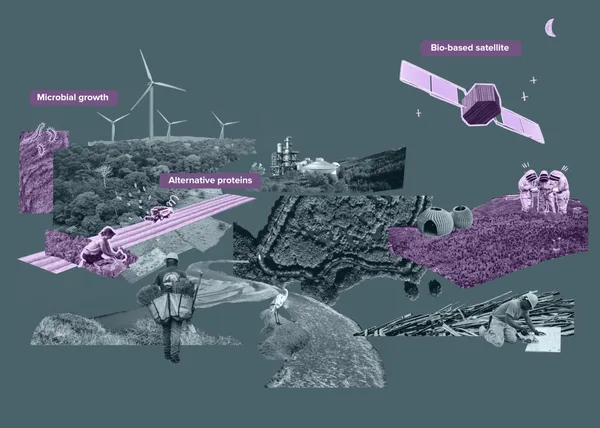
BioSolutions, such as alternative proteins and microbial growth (which Novonesis spend much of their work developing) may be key mechanisms through which a bioeconomy can be advanced. Illustration: Eva Oosterlaken / Futurall, Sourced images: Alastair Johnstone / Climate visuals (woman on farm, bottom-left), all sourced images.
Can you describe a recent moment or experience on a project that has particularly stuck in your mind?
I recently supported work serving as a member of the (deep breath as it’s a long title); “Ad Hoc Technical Expert Group on Allocation Methodology to support operationalization of the Cali Fund for the Fair and Equitable Sharing of Benefits from the Use of Digital Sequence Information on Genetic Resources”. The Cali Fund is a new and innovative approach to sharing benefits from the use of genetic data derived from nature. It aims to foster collaboration between especially the public and private sectors and indigenous peoples and local communities.
If that sounds like a complex subject, that’s because it is, but what stuck most with me is that complex
doesn’t always have to be complicated – and that the way to cut through complexity is actually very simple. It’s called aligned collaboration. Whilst working against tight deadlines, every person involved brought very different perspectives and backgrounds, cultures and languages, contributing from locations in literally every time zone under the sun. Adding these factors to an already intense topic could have easily proved too much. But by ensuring commitment to a shared goal from the outset, building trust and mutual respect along the way, and continually focusing on the bigger picture and the positive upsides of collective agreement, successful, pragmatic outcomes that can be taken forward were reached.
What are some of the hardest challenges you're grappling with right now?
There has been a lot of recent discussion around what I call the “Negative Narrative” around sustainability - and its apparent demise. But when you talk to investors and partners and look at data on longer term trends on what’s happening in the real economy, it takes away some of that volatility and enables more nuanced analysis. What I then see is less of a downgrade and more of a pivot towards thinking and implementing sustainability in terms of three “R’s” - Resilience, Risk and Reward. And that is an opportunity to re-energize conversation. However, what does concern me and can easily become an even bigger challenge than we already have is climate change. Any time left to slow down action or scale back implementation on what has already been agreed has now gone.
What are the most exciting developments you are seeing in your space?
In simple terms, the ability to continue to harness the power of nature through biology to address global challenges through innovation is something I get to see every day when I walk into work and go past the labs. Picking one development from the 30 plus industries Novonesis works in is almost impossible but getting to see how transportation fuels can be made from residues and waste, how plastics can be recycled or carbon can be captured and stored using BioSolutions is amazing – also as sustainability considerations are part of an integrated business case. What excites me the most is that all these developments combined continue to reduce emissions whilst driving growth. Simply put, economics and environmental issues are just two sides of the same coin, being leveraged by technology.

Biofuel demand continues to rise and is one of many bio-based innovations aiding the transition to more sustainable futures. Photo: engin akyurt via UnSplash
You're organizing a gathering to discuss new approaches to the transition to a sustainable future. What does it look like, what would it focus on, and who would be around the table?
Firstly, I’d get rid of the table, confiscate all electronic devices and make everyone sign an “NDA” – which in this instance stands for “New Dialogue Approach” with the following clauses: No advanced preparation, and a requirement to engage and interact using your head, hands, feet and heart.
Secondly, it’s off to a certain beach in an emerging economy, firstly for some proper surf lessons which will involve at least one big and slightly scary dunking under water. This form of “immersion therapy” is one of life’s best levellers when it comes to understanding the power of nature and your own place within it. Afterwards, being physically out of your depth forces focus without distraction, on reading the environment around you, breathing, and on experiencing the difference between power and technique when taking a decision and executing it. Afterwards, time will be spent visiting local schools, supermarkets and shops, and understanding how much things cost and where they are made, as well as looking at where the energy and water that supports the lifestyles and livelihoods of the local community comes from and how it’s produced, and what locals’ dreams for today and hopes for tomorrow are.
Thirdly, comes the key part. Getting people to think, feel and speak openly from the head and the heart about what they will have seen – challenging them to open their eyes to the pollution on the beach and in the water that didn’t used to be there and shouldn’t be there; on the pressure to secure and have access to functioning electricity and sanitation; on how people are living today; on the pressures on land availability and use, and what the next generation are learning and want to do with their lives. And then ask them to apply the results of the “immersion therapy” and go and observe their own communities and life in the same way – and ask of themselves and of others how they can do things better, differently and make a difference.
Who gets to come? As much as I’d like to invite some amazing friends, colleagues and collaborators, I would try and invite from organizations that aren’t usually part of these types of dialogues to provide fresh ideas and inputs. And from the business community I’d pick the number 2 company in every major industry to encourage more competition. For whomever comes, social skills are welcome, but social media stays at home.