Transformative adaption and renewal
As adaptation becomes an increasing focus for many, we explore the distinctions between incremental and transformative forms of adaptation – and how more ambitious approaches and their financing are crucial to a future where we can thrive


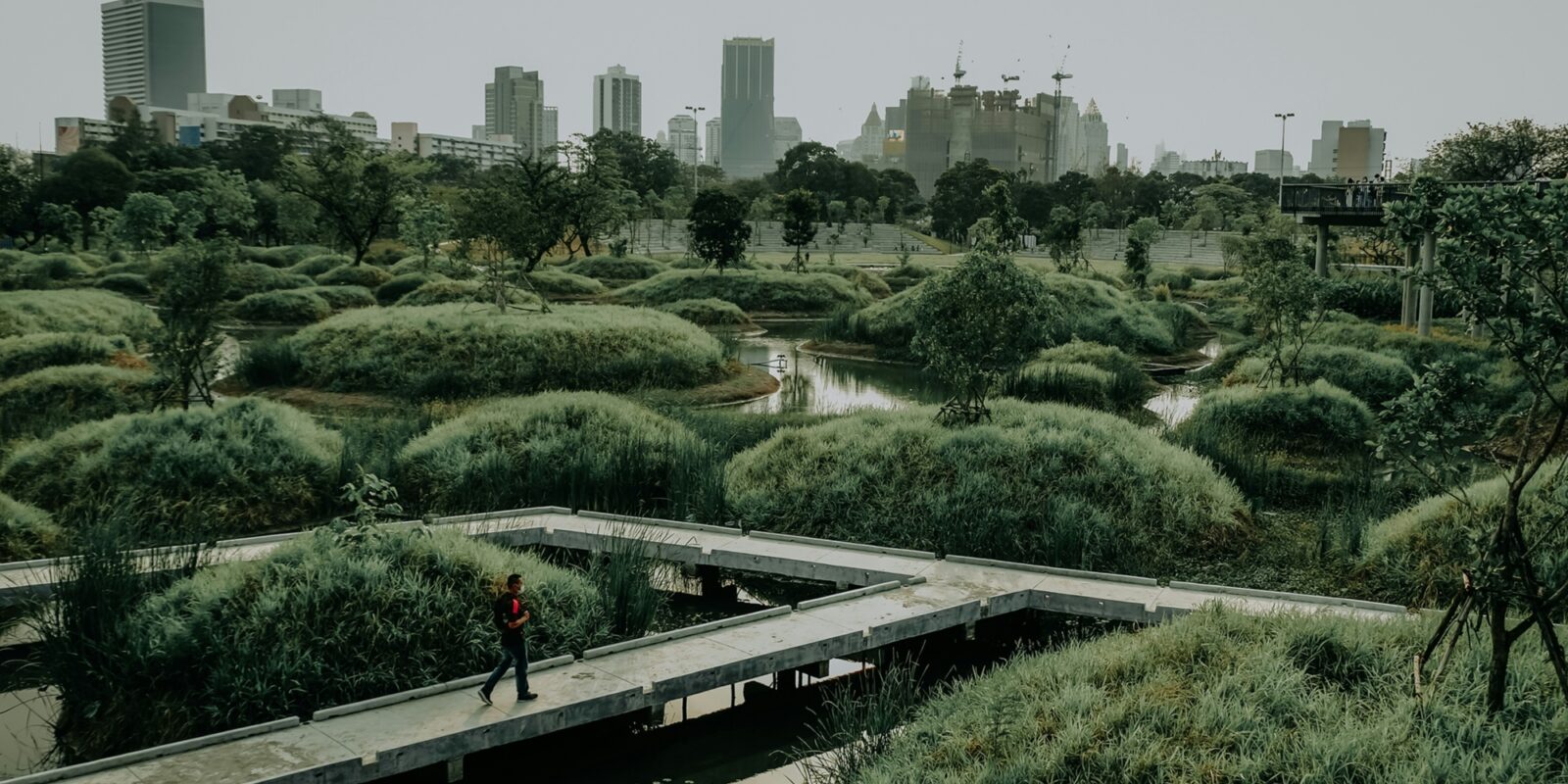
Photo via SASI on Unsplash
A Moment for Adaptation and Renewal
Adaptation is a prudent and necessary response to both global and localised impacts of climate change. It increasingly finds centrality in the agendas of UNFCCC workstreams, COPs, private sector and the finance community. More robust responses to climate challenges lean into an emphasis on transformative adaptation.
But not all forms of adaptation are equal. And as the focus on adaptation intensifies, it becomes increasingly important to understand the difference between incrementation forms of adaptation and transformative ones. Incremental adaptation refers to minor and reactive adjustments made to existing systems to retain their original functions and longevity. For example, adopting drought resistant seeds for agriculture rather than shifting away from flood irrigation and mono plantation. In contrast, transformative adaptation sees change across sectoral and spatial scales: in how the system is structured or functions, to create deep and long-term changes in society and the environment. This allows for more ambitious strategies and an opportunity to brings us closer to a more sustainable, resilient, and equitable world.
Adaptation measures can exist along a spectrum from incremental actions to longer term, transformative actions that stimulate systems-level change. The former more defensive tactics may appear attractive but don’t address the systemic nature of the climate problem and can create derailment risks. This manifests with precious resources diverted away from mitigation while retaining ineffective, siloed, unequal and maladaptive approaches to climate change. Cyclically, further increasing systemic fragility, with spill over impacts for geopolitics and the economy.
Instead, transformative adaptation is about finding novel ways to deliver both mitigation and adaptation as well as different ways of approaching issues. Also important to note here is that in some instances, incremental adaptation can be used to build up and break ground for transformational adaptations to emerge. Rather than protecting ways of functioning or systems that no longer support a thriving environment and human life, it focuses on forging new collaborations across business, government, and society. Which translates into planning processes that are more cognizant of non-linear trajectories, tipping points, and worst-case scenarios, GDP fluctuations, etc.
But transformational adaptation isn’t just about technical pathways. It also opens a valuable discussion about the kinds of society and economy we want to build. Thinking in this field focuses on a few related elements:
- Decision-making centring trust and collaboration, delivering multi-benefits, increasing the credibility of governance actors by expanding the ‘expert’ base.
- Nature dictating how resources are managed, private ownership does not remain distinct from environmental shared stewardship.
- Time being understood on a larger-scale horizons, fostering long termism in value creation.
Defensive, Shallow and Transformative Adaptation in Cities
Cities provide a clear way to examine the distinction between incremental and transformative adaptation: do they follow ‘business-as-usual' (BAU) growth trajectories or do their development and infrastructure plans incorporate worst-case climate scenarios? When climate collapse risks are not sufficiently factored in, societies experience increased fragility in areas that are already vulnerable to extreme weather patterns. Cities continue to expand suffering from erratic rainfall, reducing groundwater reservoirs, bringing severe droughts or floods in a seesaw of climate volatility.
A historically water-scarce Iran, moved away from its ancient qanat aquifer systems to becoming one of the world’s top dam builders. Iran is currently facing a multi-systems strain (inflation, land subsidence, water and energy shortages), leading to both crippling political burnout and massive social unrest. Its capital, Tehran, is facing a multi-year drought, exacerbated by inefficient agriculture, the region’s water-intensive oil industry, and complex water geopolitics.
While the city has discussed relocation plans due to water bankruptcy, Iran’s sees a brutal crackdown on citizen protests (that have been fuelled by the climate crisis). But, with consequent threats of sanctions issued by the G7 to stem this violence, these plans have been stalled. Iran stands as an example of limits of incremental approaches to adaptation, that short-term planning cannot lead to long term peace and prosperity in the face of climate change. Situations that can emerge across the globe in cities struggling with similar challenges.
In contrast to Iran’s defensive adaptation, Indonesia attempted to approach water scarcity in its capital city of Jakarta (also the fastest sinking city in the world) differently. It proposed a relocation of the city to newer capital (estimated bill: USD 35 billion) and building a mega sea wall to defend Jakarta against sea water encroachment.
The Jakarta case is an interesting example of taking up proactive planning before full disaster strikes. However, despite the impressive scale and creativity of the interventions, Jakarta’s example sees issues like water scarcity and flooding remain unaddressed. Such shallow adaptations are not only costly on the national budget but reinforce decision-making patterns that prioritise big tech and government as the ‘only’ solution providers. They also risk causing further negative environmental impacts and embedding social inequity in the ‘new’ futures it reimagines.
On the other hand, after the city of Copenhagen in Denmark suffered catastrophic flood in 2011, it went with a more system-led thinking in its response. The government moved beyond conventional drainage to green and (re)engineered public infrastructure as part of their urban planning to achieve its ‘sponge city’ status. Sponge cities are defined as an urban area that uses its natural infrastructure to absorb excess water in a flooding event with parks becoming reservoirs for heavy rains. Their example shows how extreme weather risks can be managed with nature-based and hybrid (blue and green) infrastructure solutions. As part of Copenhagen’s long term climate adaptation strategy, it is also building a new island, Lynetteholm, to protect from storm surges and provide homes for 35,000 people.
Copenhagen’s sponge city approach is an example of transformative adaptation that goes beyond defensive or shallow approaches to redesign its future under more wet and extreme climates. It reshaped its streets, parks, and public spaces, improving water retention capacities, all while improving everyday liveability for its citizens. These sets of actions practically embody the goals of transformative adaptation: when the city was confronted with it new climate reality, it adapted in deeper ways that were proportional to the scale of the problem.
Financing Transformative Adaptation in Cities
Finance is an important mechanism to drive the kinds of changes and positive progress that will drive transformative adaptation. Transformational approaches to adaptation in the finance sector are not only possible, but emergent: platforms like World Business Council for Sustainable Development are improving investments in nature by supporting the integration of climate, nature, and equity into corporate strategies and decision-making. Similarly, there is a rise of dedicated collaborations between the private sector and nature investment experts to reimagine investment futures and unlocking capital critical to enabling transformative adaptation.
Cities need robust finance channels and mechanisms to bring their visions of transformative adaptation to life. In Copenhagen, flood adaptation wasn’t paid for by any one single or pot of money. They used a financing model that drew on various sources like concessional loans, co-financing with public budgets from taxation, water tariffs from the utility company, and private financing from landowners. The city intentionally combined different funding sources, each paying for a part of the bill that best matched its role, creating what is known as a blended financing solution. The city's particular public-private partnership (PPP) format has been popularised and studied as the 'Copenhagen Formula’, having demonstrable viability and scalability across other global cities.
Copenhagen shows that transformative adaptation does not need to be a one-time public expense but part of a shared, long-term climate financing system. In contrast, Jakarta relies more on heavy public borrowing, foreign and private investment for its mega-scale sea wall costing USD 80 billion a land value capture mechanism as part of its own PPP scheme.
The banking sector can play a role in facilitating private investment in transformative adaptation. By investing in more long-term, regenerative and nature-based approaches, the banking and finance sectors can help address bottlenecks in capital flow and reclaim their agency in shaping solutions in an economically uncertain world. Their practices send important signals in the current financial system and them to play a more active role in seeding ecosystems and eco-landscapes (think: more places like sponge cities) through investments and/or donations leading to social and economic returns.
Transformative adaptation unlocks new response pathways to climate change. Where traditional adaptation might prescribe a series of reactionary adjustments, transformative adaptation aims for novel and exciting innovations for shifting our current systems and its ways of operating. This is where some of the most interesting work is happening: bringing together the capacities of large institutions with the creativity, knowledge and energy of real-world communities to unlock solutions that do more than just manage risk
To make this possible, governance, planning and investment will need to hold the spirit and values of transformative adaptation close. More institutions and procedures will then adapt to deliver responses with multi-benefits and connect leadership across sectors and scales. governance and business leadership at different scales. In cities, embedding more transformative adaptation into urban design and financing mechanisms can help reduce future vulnerability. Equally, more momentum can be built to create cities that are healthier, fairer and more resilient, because climate action is not just about responding to crisis and loss but building better futures, with decision-making that protects places, people and the planet.