How a gender perspective can strengthen adaptation efforts
Reflecting on International Women's Month, we explore how climate adaptation can be strengthened through gender sensitive approaches


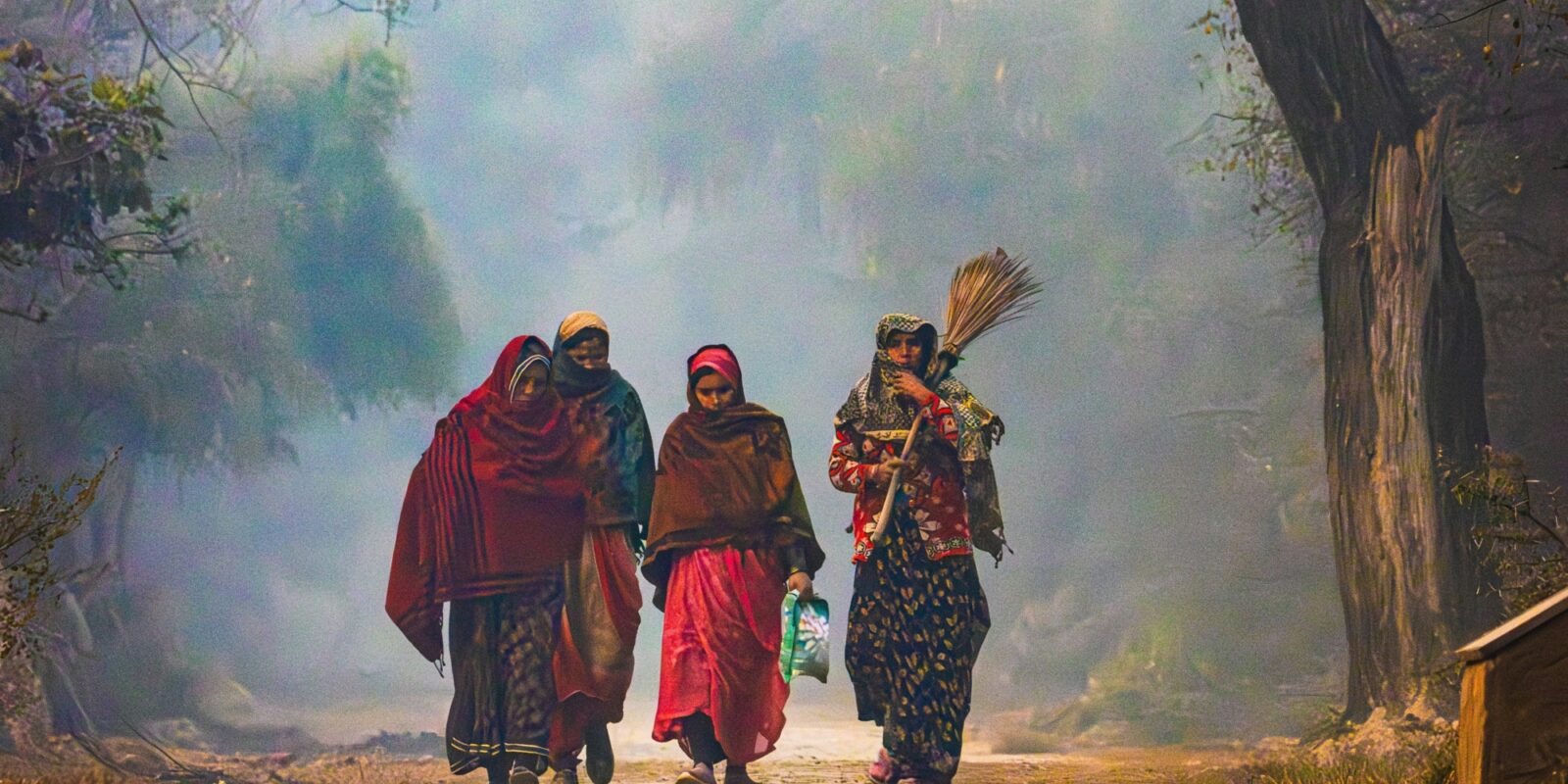
Women villagers step out for their daily work, moving gently along the gravel jungle path beneath the towering canopy of tall trees. Photo: Anushtup De via Unsplash
Our ability to cope on a warming planet will be defined by how we implement adaptation in combination with mitigation to cope with the growing impacts of climate change. We will need tools and strategies that go beyond technical fixes to address the hazards that climate impacts will bring and equally invest in addressing social and economic challenges. This International Women’s Month, The Accelerator has been reflecting on how a gender sensitive approach to adaptation can illuminate the socially-constituted inequalities that climate change exacerbates, and propose a more robust set of solutions, that build our resilience to climate shocks and prevent carrying forward the inequalities that defined the fossil fuel era.
Research confirms that gender inequality worsens vulnerability to climate change, and if adaptation measures don’t address gendered power dynamics, that vulnerability could get worse. A changing climate, characterised by post 1.5, will mean the emergence of new social contracts, economic models and, potentially, power relations. How we go about adapting to climate change in this Rift will be the difference between further entrenching inefficient power asymmetries between genders or overcoming historical biases to launch responsive outcomes that last.
By examining climate risks through a gender lens, we can gain deeper diagnostic capacity that enables the design of adaptation measures that are more comprehensive, durable and relevant for the whole population, rather than solely serving a limited set of needs.
In this article we briefly explore how a gender lens can lead to better adaptation outcomes at the level of environment, society, and economics by covering the role of better participation, usage of data and widening gender roles.
Environmental resilience grows when women are included
Climate policy actions have historically concentrated resources on mitigation efforts, to try to reverse these impacts through decarbonisation.
While these activities are important, climate action can also be used to deliver multiple socio-economic benefits. Nature-based solutions can deliver the simultaneous effort of mitigation, while also enabling us to adapt to environmental fragility. Examples include, tools like wetland restoration to protect against flooding, mangroves for coastal defence, and regenerative forestry for carbon storage, - all of which can all also deliver air quality improvements, temperature regulation, water purification, disaster risk reduction, and improved sustainable resource management – tangible benefits to place, people and the planet. However, effective implementation of these complex processes requires deep knowledge of how nature, environment, and society interact. Women have a crucial and under-valued role in climate decision-making, embedding gender-inclusive participation and decision-making in adaptation efforts can impact how effective, at scale, and accelerated these solutions can be delivered.
Through their often culturally determined roles and responsibilities, women have typically been stewards of nature-based knowledge and their perspectives need to be included in planning, decision-making, and implementation processes. For example, in central-western Bolivia, an extended drought period reduced water levels and exposed Lake Uru Uru to water pollution from local mining activity. As a result, the water was too toxic for fishing, drinking, irrigation, and livestock and a community that was once made up of 3000 inhabitants dwindled to about 500. It was through the work of 60 Indigenous women from the Vito Villachallacollo community who in 2019 rehabilitated Lake Uru Uru using Indigenous knowledge and scientific methods to develop floating rafts that reduced heavy mental contamination by 30 per cent. In addition to restoring the lake, the women successfully mobilised the community and secured sustainable financing for further raft construction. The women from Vito Villachallacollo did not stop at ecosystem restoration, they are developing a locally run lab to study phytoremediation to continue lake restoration and deliver further benefit to the community to provide employment and educational opportunities.
This story of leadership and access in Vito Villachallacollo is far from unique; research on the agriculture sector, where women are overrepresented, finds that if women had the same access to resources as their male counterparts, farm yields, for example, could increase by 20-30 per cent. Women’s exclusion delays the implementation and effectiveness of climate policy and adaptation measures by limiting knowledge, talent, and innovation. In short, making women meaningful participants and leaders isn’t just a question of equity – it benefits everyone through improved access to and control of resources, protection of traditional knowledge and cultural practices, and enhanced community cohesion.
Gender-data for improved social well-being
Climate change has cascading and intensifying impacts on social wellbeing. For example, declining freshwater availability and groundwater depletion are negatively affecting communities’ health outcomes and food security, while climate disasters are displacing populations and forcing migration. Too often, adaptation responses treat these challenges as though they are experienced uniformly. It is widely evidenced that social and cultural dynamics, like gender, are determinants of how these impacts are experienced.
Gender norms often dictate how space is used, who has access to resources, and who is responsible for certain productive activities. Clarity on these dynamics come from available and accurate data. There is a shortage of gender-data that poses a barrier to effective of adaptation and resilience. An adaptation response like early warning systems to alert populations of natural disasters can be more responsive when planners and decision-makers have the information to understand the different needs of the serviced community. A report from Chatham House finds that gender, among other social identity markers, affects access to early warning information. A report by Practical Action, highlights how women and vulnerable groups were missing from primary data that could impact how effective early warning systems are at notifying them in the event of climate disaster.
The OECD’s Gender Policy Marker has been used by Sida, the Swedish International Development Cooperation Agency, and OECD-DAC member to classify and monitor funding that promotes gender equality in different sectors. The Gender and Environmental Data Alliance (GEDA) is a network of 90 organisations that are working to improve gender-responsive climate action using gender-environment data. These efforts, however, are not mainstreamed across environment and climate, highlighted by a lack of high-quality, regularly collected and globally comparable gender data for climate and environment issues. The collection and analysis of gender-data, in the form of gender-disaggregated data, gender policy markers, and gender sector markers support evidence-based climate action and effective implementation. Gender-data can illuminate differentiated impacts, ensure climate actions accurately addresses women’s needs, and lead to more targeted investments and stronger accountability. Gender-data makes women visible in climate adaptation policy and narrows the gap between how adaptation is addressed and how it is experienced by women.
Recognising the care economy
A key theme in the Accelerator's research into adaptation is the vital importance of social capital. Whilst it's easy for conversations about adaptation to focus on major infrastructure projects, extensive evidence shows that social relations are a key factor in how resilient communities are. Common adaptation responses intervene at the level of the formal economy – these important mechanisms have an opportunity to work more effectively, by going further in scope, towards recognising informal and unpaid labour and financing these less-recognised economic backbones of resilient societies.
Adopting a gender-sensitive lens unearths a wealth of economic activity that official metrics and adaptation policies obscure. Domestic labour, community care, and the social bonds that tie households and communities together are foundational networks that enable societies to absorb shocks and build new systems to adapt to a changing climate. Women play a major role in driving this 'care economy’ which creates the conditions for economic productivity – yet its contributions are rarely valued as such. Instead, this work is understood not as labour that drives economic flourishing, but as acts of love and care to be taken for granted. As Silvia Federici’s provocation during the 1970s Wages for Housework campaign, went: “They say it is love. We say it is unwaged work.”
The stakes of this invisibility are high: according to the ILO, women around the world perform 16 billion hours of unpaid work, and if this labour was given a monetary value, it would exceed 40% of many countries’ GDP. Climate change directly compounds these burdens: a study in Delhi and Dhaka found that women spend an additional hour per day on care work when a family member suffered a climate-related illness, for example, a water-borne disease from torrential rains. And, as formal livelihoods collapse under climate pressure, women increasingly absorb the slack through intensified informal and subsistence work: fetching water from further afield, managing household food scarcity, and holding together the social fabric of displaced communities.
Addressing this gap means rethinking what counts as economic value in adaptation planning: recognising informal labour, redistributing access to resources, and designing finance mechanisms that reach those whose livelihoods sit outside the formal economy. Greater investment in cultures of care ensure societies experience less disruption, and bounce back faster when problems arise. A well-functioning care economy not only supports individuals and families, but also contributes to a healthier workforce, creating jobs and enhancing productivity. Recognising the care economy is a matter of ensuring adaptation effectiveness.
Gender sensitive approaches and better futures
Women’s participation, knowledge, and labour are already sustaining communities in the face of climate shocks. Their climate relevant knowledge, representation in data, and labour are all ways that women contribute to the better future that is being built. A gender-sensitive approach to adaptation planning offers a pathway where decisions are better informed, governance is more inclusive, and investments are better targeted to the needs of society. More deliberate gender sensitivity in climate adaptation enhances our ability to navigate uncertainty, protect ecosystems, and build better futures for all.