Leadership in rupture - lessons from the medics' trial
During January 2026, we held the latest in our series of Accelerator Sessions – invite-only, one-off creative events exploring frontier issues for the transition. Here’s what went down.

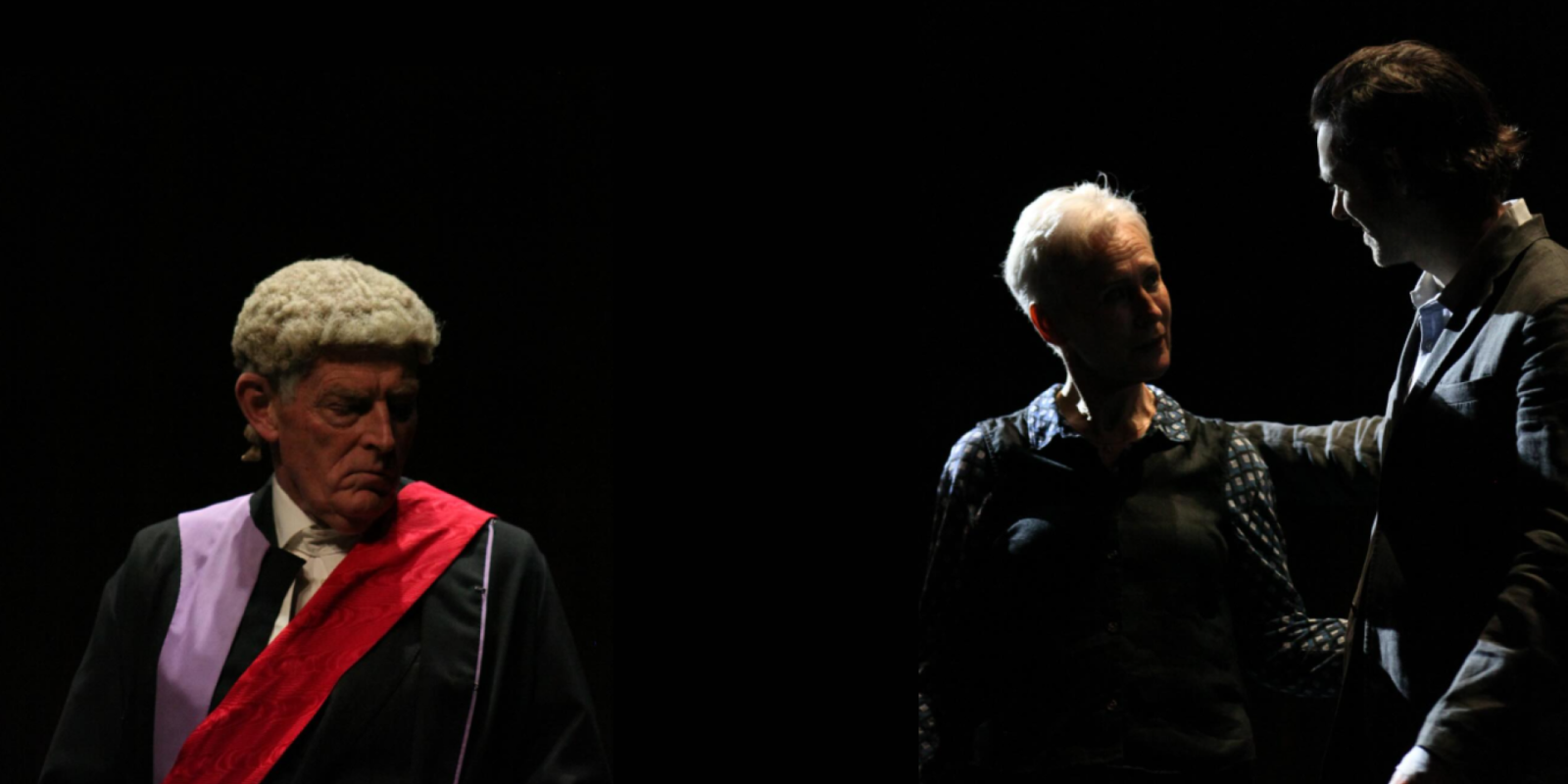
A still from the play. Photo credit: Archie Redford via @empathymuseum on Instagram
At the beginning of this year, Southbank Theatre hosted a one-week run of In Case of Emergency, a new theatrical work by award-winning Director Ian Rickson. Based entirely on verbatim transcripts of real Court proceedings, In Case of Emergency detailed the story of six medics who were tried for damaging the windows of JP Morgan in protest against their fossil fuel investments. Exploring the medics’ defence - that they took “minimal intervention” to avoid harm - the play worked as both a legal drama and an ethical case study – as the clinicians attempted to explain their duty to protect life within a system that criminalised their efforts.
At the Accelerator, we’re firm believers in the power of culture to open up new spaces for critical dialogue and collective progress, so this opportunity was too good to pass up. Using it as a launchpad for the latest of our Accelerator Sessions, we invited a group of leaders from the private sector and government to watch the play, meet the Director and creative team, and then gather under the Chatham House Rule to discuss the experience. In Case of Emergency centres on health professionals who refused to treat their ethical codes as purely private matters, instead leveraging their professional profile and expertise to urge a broader public conversation. So, we asked the group – what does their story have to teach us about leadership in a time of rupture?
SPEAKING FROM CONSCIENCE AND AUTHORITY
The medics’ original protest occurred in 2022, and in many ways that world feels like a distant memory in 2026. Following a decade that saw sweeping public declarations on climate, gender and race from a range of institutions, recent years have have led to an observable hush even as risks intensify. As a recent FT article notes, in many areas “the silence is deafening”.
But not everyone is missing in action. Behind closed doors, many remain committed to substantive change. In the public arena, actuaries, insurance leaders, politicians and governments have all issued remarkable statements underlining the existential consequences of delayed climate action. As the play and accompanying transcripts make clear, the action of the 6 medics can be seen as part of this story – a committed group of expert professionals, drawing articulate links to the ways in which action on climate was part of their professional duty of care as clinicians, framed as a means to prevent a medical emergency. Explaining the rationale for an action they took during the record-breaking heatwave which was associated with over 1200 excess deaths over just a 4-day period, notes issues by the defendants explain:
'Collectively the healthcare professionals say they are bound by the principles of beneficence, non-maleficence, justice, and respect for autonomy, and emphasise that these principles do not exist in a vacuum, but are tested most severely when the state or corporations become a source of harm to patients. When government actions or policies - whether through direct or indirect violence, environmental destruction, or the suppression of dissent, threaten the survival and wellbeing of populations - their duty is not only to treat the wounds, but to address the root causes.'
In the case of the medics and the other examples cited above, there is a clear sense we are moving beyond the widescreen Declare Emergency moments of the 2010s. These are careful narratives, served up in the language of specific communities, rooted in personal conviction and professional expertise, and placing close attention to how climate issues intersect with the roles and interests of specific sectors, professions and communities. Less brash perhaps, but better able to persuade.
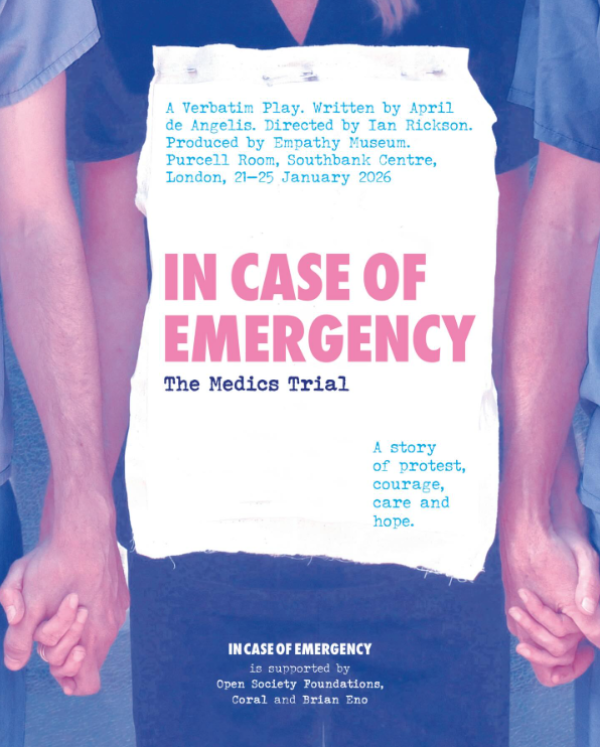
A poster advertising the play. Credit: @empathymuseum on Instagram
STORIES AND LEADERSHIP
Such ideas of expertise and narrative were at the heart of our group’s discussion following the play. As one participant noted, leadership isn’t only about bold action, it’s also about lighting a path where others will follow. And this, inevitably, relies in finding a common narrative. Neither climate change not societal change are just about data, strategies and charts. They are also about the stories we tell each other, the narratives that guide and frame our actions as individuals, institutions and societies.
Those stories are changing. As the 2020s progress, it has become commonplace to argue that the unifying narrative of Net Zero is fragmenting, with dangerous consequences. This is partly true. Although both limited and limiting, the frames of 1.5 and Net Zero clearly served as helpful mechanisms to forge a wide alliance across private sector, government and civil society. They also generated significant progress – in the UK, our emissions are now at 50% of their 1990 levels. These are successes we should take pride in. But the context is evolving, rapidly.
It is partly driven by a combination of cynical denial and the febrile headwinds of national and international politics. But the story is more complex than that. As we begin to breach 1.5 degrees of warming, dynamics change, motivations shift and the logic behind historical coalitions begin to change. For many, continued focus on 1.5 is a crucial strategy to eke out every ounce of progress from governments who have legally committed to it. For others, holding on to these narratives begin to represent a barrier to what they feel must be done. Spatial and sectoral differences matter, too. As severe climate change from future predictions into lived realities, the impacts are asymmetric – bearing down much more forcibly on certain regions, communities and sectors. The challenges to Net Zero as a unifying goal are a collateral damage of this dynamic – for those who view disruption at a distance, emissions reduction remains a natural focus. For those most impacted, many are understandably drawn to refocus on more immediate challenges of survival, adaptation and resilience.
This presents challenges, but it should also be seen as a moment of experimentation. If you're natural scientist, think of it as a Cambrian explosion in societal understanding - as a whole range of actors are exploring new ways to understand their present and shape their future. Or if you’re from the world of innovation, we’re in the third stages of a double diamond moment – where innovators explore wildly different answers to a clearly defined problem. New stories, new alliances, and new coalitions that criss-cross society, business and government in new ways.
The medics are part of this lineage – combining tried-and-tested forms of civil disobedience with the specific mandate of clinicians to mobilise the medical community in new ways. There are many other examples. Risk professionals are re-orienting their communities around systemic risk whilst urban professionals are exploring ideas of transformative adaptation. Policy advisors are using derailment risk to urge a broader governmental view of securing the transition, whilst community activists urge us to hospice modernity. Each of these examples can be understood as pioneering attempts to understand and shape the world to come. Ideas that seek to capture the swirl and complexity of this moment, in all its challenge and all its promise. Those that succeed will be the ones that are most successful in finding stories that reach beyond their domains, folding in the roles and interests of a wide variety of communities and institutions.
What does this mean for leaders in time of rupture? Three messages stood out from our discussion. One: in a rapidly changing landscape, many leaders continue to underestimate their capacity to shape a public dialogue. As medics and actuaries have shown, leaders in every context can find ways to leverage the specifics of their mandate, authority and expertise to advance collective action. Such work continues to be crucial. Two: as traditional coalitions continue evolve or fray, the most promising opportunities for collaboration may emerge from the most unlikely of places. Net Zero generated unlikely partnerships and huge opportunities to align individual and societal interests. For those at the forefront, the next wave of the transition will do the same. Three: never, ever forget the power of a good story.
To conclude, we share a selection of the words of the leaders who came along to the play with us:
"We have walled ourselves up … In large businesses, leadership would often take the view that you're either with us or against us. There was this unbelievable kind of circling of the wagons. Anybody who criticises us is just committed to our destruction. But those kinds of barriers hold us back … I’m increasingly of the view that leaders in key institutions have a moral responsibility and duty - not only in how they act internally, but also to reach across the barrier and work with those outside their institution …to create ways of working where others win … this is not about technological innovation – social imagination is the key”
FOOTNOTES IN JUSTICE - THE 2026 RETRIAL
The play and accompanying Accelerator Session took place one week before the retrial of the medics. The trail concluded this week, with remarkable results. Although we focus here on the themes of our Accelerator discussion, there’s a broader story here – involving ongoing efforts to limit trial by jury and remove jury equity, accompanied by what the UN Special Rapporteur General terms “increasingly severe and draconian measures against environmental defenders” in the UK system.
In the context of these efforts and increasingly vocal attempts to deny the science and physics of climate change, it’s reassuring to see how the Jury in the 2026 trial responded. Directed by the judge that there was no means to acquit the defendants, a diverse cross-section of the British public from all walks of life excised their right to jury equity and delivered a unanimous “not guilty” verdict.