Prisoners' dilemmas, games and building better futures
Continuing our series of interviews with leaders in their respective fields of the climate and nature transition, this month we sat down with David Finnigan and Melanie Frances, who work with governments, business and research institutions to model complex systems and future scenarios.


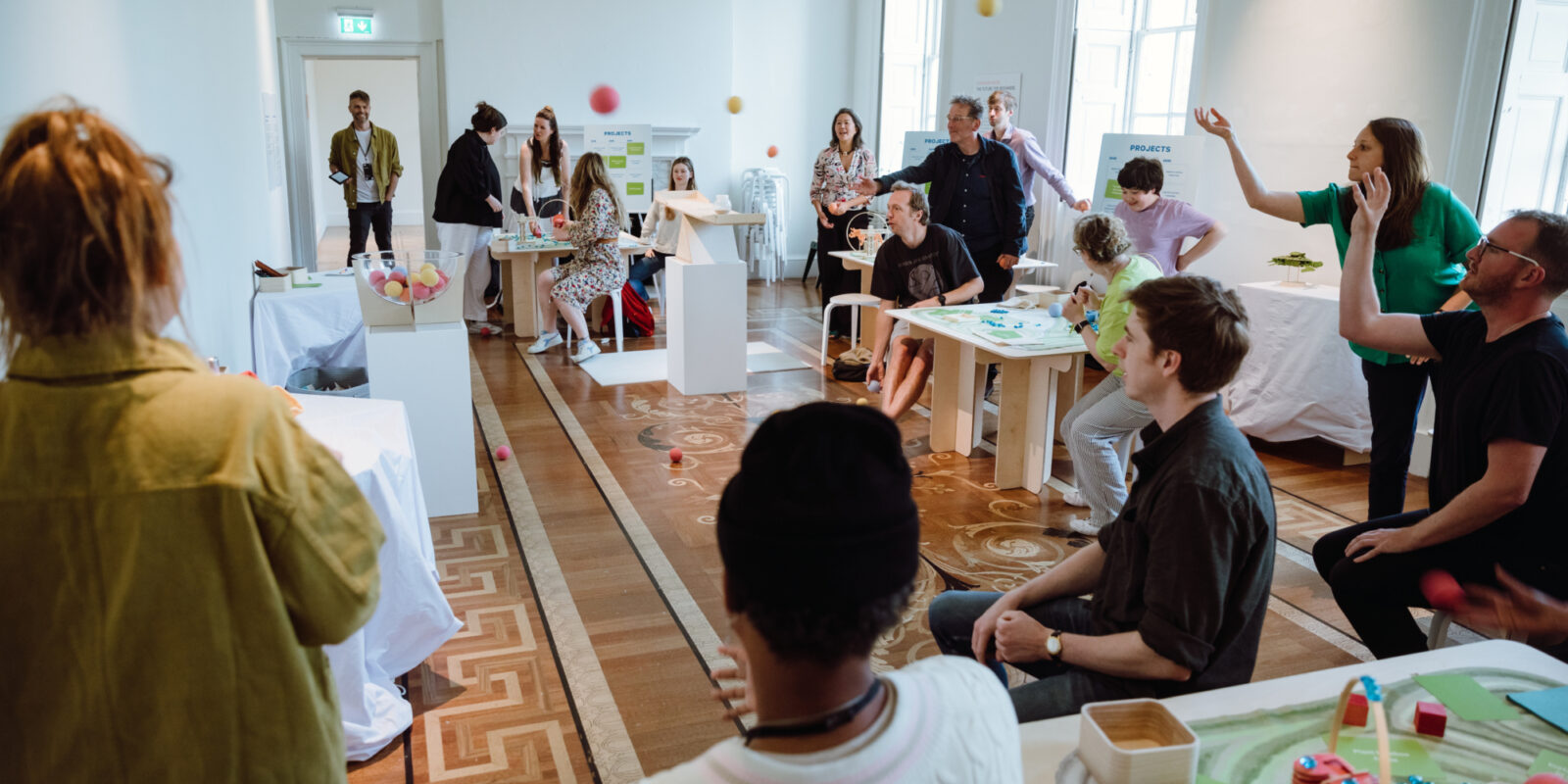
Mel and David hosting their game 'Futures for Beginners'. Credit: Timothy Spurr via David Finnigan
As part of this series we are interviewing a range of influential and inspirational leaders from across the climate and nature transition. These interviews are intended as a window into innovative and exciting ways of approaching the transition and to spotlight the people who are at the forefront of these changes. Here, we sit down with David Finnigan and Melanie Frances who work with governments, business and research institutions to model complex systems and future scenarios and produce games and workshops. David and Mel have created games for partners including the World Bank, the UN, and the Stockholm Resilience Centre. Their game The Future for Beginners was commissioned by the Chatham House Sustainability Accelerator and featured at the 2026 TED Conference in Vancouver.
Name one object that you currently have on your desk
MEL: Having only just unpacked, it’s my notebook of responses and ideas from this year’s TED conference in Vancouver. I was invited to this year’s conference to run workshops of the game David Finnigan, Becky-Dee Trevenen and I developed in partnership with the Sustainability Accelerator - The Future for Beginners. Set on a small peninsula in which five towns are preparing to throw a major cultural festival to revitalise the area, participants role play for 80 minutes as leaders of these communities, navigating political pressures, economic constraints and climatic shocks to try and deliver a successful cultural event.
Running the game is always great, and more broadly, it was a week full of new challenges, concepts and questions; some felt like warnings, and others like open doors of opportunity. My favourite talk from the week was one delivered by Carissa Véliz, in which she explores prediction and prophecy. It's just been uploaded here, and offers a fascinating exploration of prediction ‘as power plays in disguise’. I’d definitely recommend watching!
How would you explain what you work on to a five-year-old?
DAVID: We create games about real world problems. By playing these games, people can come closer to solving things in real life.
One step more complex (perhaps for inquisitive fifteen-year-olds!): we work with government, business and research institutions to model complex systems and future scenarios. We turn these models into rich experiences for people to engage with, using narrative, design and interactivity.
Presented as games and workshops, these models are designed to help people better understand the systems they’re part of, to help them make better decisions, and to train useful skills.
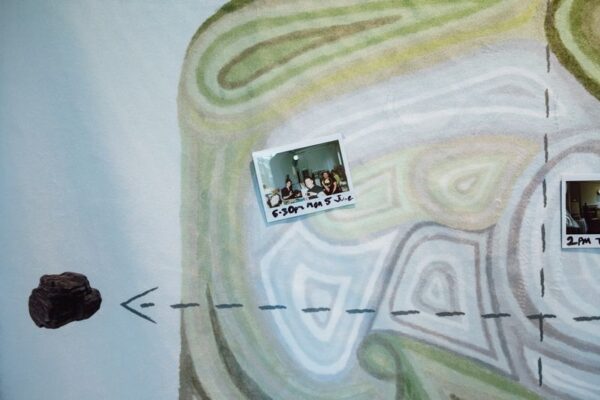
A snapshot from 'Futures for Beginners'. Credit: Timothy Spurr via David Finnigan
Can you describe a recent moment or experience on a project that has particularly stuck in your mind?
MEL: For me, what always sticks out are the conversations we have after we run a game. The Future for Beginners game has a few prisoners' dilemma moments: where players can choose to collaborate (or not) on communal land regeneration projects. If most people choose to collaborate, then everyone benefits, but if only some choose to collaborate and others don’t, the ones who have opted in make a loss.
It’s fascinating to talk to players about their approach to decision making in the context of this dilemma. In the throes of the game, even those who knew the prisoners' dilemma well, and would have advocated for the benefit of multi-lateral partnerships, (and the vital need for these land regeneration projects), found themselves choosing not to collaborate. In a discussion after a game, a player once said to me “I found myself doing all the things I tell everyone else not to do!”
For me, this is the game at work! I love seeing how practically playing the game and working through scenarios can challenge assumptions and shift perspectives. I hope this has the potential to expand our thinking, build collective empathy, and help us find new ways of building the collaborations and coalitions we need to navigate the next stages of the transition.
What are some of the hardest challenges you’re grappling with right now?
DAVID: We are embedded in systems. Climate systems, economic systems, political systems, social systems, ecosystems. These systems are too vast and complex for any single person to understand - and yet we must understand them, because we face shocks and crises at every scale across the systems we inhabit.
In this context, our job is to create interactive, playable models of these systems to help policy-makers comprehend them and make useful interventions. One difficulty is that when we create our games, we have to be mindful about who we are creating them for; our games and scenarios have to work for people who have never encountered the system before, while also being meaningful for subject matter experts. They must reveal complex system dynamics, while working for a group of players who are experiencing the game for the first time.
It’s a hard balance to strike, and it’s never straightforward, but then grappling with that challenge is also the joy of the work!

A prop used in Futures for Beginners. Credit: Timothy Spurr via David Finnigan
And what are the most exciting developments you are seeing in your space?
MEL: I’m seeing several emerging contexts in which games about climate systems and sustainability could offer new approaches and perspectives, supporting deeper understanding and richer conversations, for example, I’ve been thinking about:
- How games allow us to look at the overlaps between strands of climate work to identify areas of mutual benefit, such as projects that support mental wellbeing and nurture local biodiversity, or simultaneously support the energy transition and develop local disaster resilience. In these contexts, games can be especially useful in breaking down siloes; helping us to see the interconnectedness of systems and the opportunities that interconnectedness affords, rather than solely focusing on single strands of work. One great recent example of this kind of ‘systems game’ is the board-game Daybreak by Matt Leacock (famous for Pandemic). Players work together to try to navigate a global transition to sustainable energy before climate change crosses key tipping points. It’s a big, messy, flawed but brilliant illustration of the interlinked social, ecological and economic systems we’re embedded within.
- I’ve also been considering how games could help to open up difficult or controversial conversations - such as global approaches to geo-engineering. Here, a game might help us prise open a conversation that is truly complicated, dangerous and urgent, supporting players to consider the reality of different approaches, towards building proactive rather than reactive strategies. In this space, the Climate Action Unit at University College London are doing some really exciting work. The CAU use principles from neuroscience and psychology to engage policy-makers in conversations about climate risk. Their approach to facilitation is rich and innovative and makes smart use of games and play to navigate challenging topics.
You’re organising a gathering to discuss new approaches to the transition to a sustainable future. What does it look like, what would it focus on, and who would be around the table?
Alongside experts from climate science, policy and business, we’d want to gather together some of our favourite game designers working in the systems gaming space. That would include artists from:
- Singapore's Centre for Applied Simulation and Training in Singapore, who are some of the smartest thinkers out there when it comes to games for policy;
- Australia’s Boho Interactive, who make brilliant science-informed games about land management and ecological systems;
- Nepal’s Mandala Theatre, an extraordinary team working on games and interactive theatre, to grapple with disaster risk and governance challenges for communities around Nepal.
And outside of the game design world, we’d definitely want to include the members of the Global Risk Communications Network, a loose affiliation of researchers and policy-makers using innovative tools to help people make sense of complex risks.
And how would it look?
We’d move from systems mapping to game play, to debrief, to planning - and then a good meal!
You can find out more about Futures for Beginners here, and read more from David Finnigan about how games can be used to unlock systems change here. Find more from our 'Interview with an Expert' series below.