The role of boards in the Age of Uncertainty
Following on from our recent roundtables in Paris, non-executive directors from the Accelerator’s network reflect on this era of extraordinary uncertainty – and what to do about it.



Conflict in the Strait of Hormuz is the latest in a series of uncertain disruptions affecting societies and businesses. Photo: Planet Volumes via Unsplash
If there is one thing that is not new and recurs frequently throughout human history, it is uncertainty. Territorial and religious disputes, as well as technological and climate disruptions, have occurred at various moments. However, periods like the present have been rarer — with an extraordinary convergence of multiple, mutually-reinforcing and highly disruptive factors all driving deep and persistent uncertainty. The situation we face today is also marked by high levels of interconnectedness and low visibility, where traditional predictive tools are inadequate to the task. This brings a much-heightened exposure to risk, but also presents unique opportunities.
For those of us interested in how to better align commercial and societal outcomes for the years ahead, ensuring business can find ways to navigate such uncertainty is key — and boards are a vital part of the puzzle. With the C-Suite frequently hemmed in by a potent mix of market expectations and imperfect operational metrics, non-executive boards play a crucial role in helping their businesses to take a long-term view of what matters – and what success looks like. And in the present era, that’s more important than ever.
With such questions circling, the Sustainability Accelerator met with key actors from the boards of financial, insurance, energy, industrial, technology, legal and consulting sectors as they gathered in Paris this March to discuss the challenges of governance, uncertainty, climate and nature. The debate highlighted several critical elements that governance bodies — especially boards — need to unpack in order to confront and overcome these challenges. In the reflections that follow, we focus on key themes emerging from the discussion.
Welcome to the Age of Uncertainty
The topic of uncertainty invites analysis from multiple angles. One logical starting point is the inevitable conclusion that there is strong interdependence between the factors shaping the current uncertain environment. These factors lie within a geopolitical arena where national sovereignty is increasingly overriding globalization, and issues such as energy and food security are becoming intertwined with climate change and growing demand for strategic natural resources such as water, land and minerals. Technological frontiers — such as alternative energy, hyper-precision agriculture, digital gene-sequencing and data management — are becoming strategic pieces on the geopolitical chessboard.
These situations are often described as wicked problems: contexts where 1) there is no definitive formulation of the multiple challenges involved; 2) there is insufficient information (with imprecise, uncertain and volatile boundaries); and 3) there are no definitive solutions. These situations affect multiple stakeholders — often with conflicting interests — so there is no right answer regarding proposed solutions, which are open to interpretation depending on the affected groups. In general, it is very difficult to test solutions before they are widely implemented, which inevitably means trial and error, and learning iteratively. Designing indicators and metrics to gauge success ex post is extremely challenging, as it is often impossible to definitively measure the outcomes of solutions once implemented, or the impact of measures to prevent “the disaster that never happened”.
Arriving at decisions is an increasingly difficult task in an Age of Uncertainty. Photo Joachim Schnürle via UnSplash
Decision-making when you cannot know
Governance practices, codes of conduct and regulations all need to adapt to this new normal. Those with oversight and fiduciary responsibility have no choice but to respond, particularly to challenges like rapidly changing externalities related to the environment, natural resources, and climate change. In addition, the business environment is quickly shifting from moral (reputational) liabilities to legal liabilities. Regulations concerning carbon emissions, protection of the ecosystem, and plastic circularity are becoming increasingly stringent, meanwhile litigation under tort, human rights and environmental laws are all gaining traction.
Such challenges require a range of new skillsets and mindsets from board members and other leaders. Some gaps in skills and knowledge are related to specific domains — for example, the need for a more sophisticated understanding of climate futures amongst many leadership teams. More broadly, there is a growing awareness that existing decision-making tools are inadequate to deal with the multiplicity of emerging factors mentioned above. In high-uncertainty contexts, neither probability-based models nor traditional scenario approaches are sufficient. Probabilistic approaches to risk use frequency distributions to attribute a measure of likelihood of occurrence. This means they tend to work well in the context of relatively predictable and stable environments, but they are poorly suited in contexts where likelihood cannot be accurately modelled. Similarly, traditional approaches to scenarios tend to focus on a limited number of future possibilities — and therefore tend to overemphasize dimensions of future change that may or may not be most relevant. In these tools and others, reliance on traditional approaches is not only ineffective; it also generates significant blind spots to both risk and opportunity.
One emerging capability for directors and companies is the evolving field of scenario planning. Scenario planning is not a well-understood nor well-established practice for many boards, nor a simple craft; however now it needs to jump to the next level of sophistication in order to confront extreme uncertainty. Using a range of tools, some boards are working to construct and explore a far broader range of scenarios simultaneously, expanding the range of possible futures. Although many of these approaches deploy cutting edge software, their main advantage lies not in technical precision but changes in culture. In the absence of precise quantification, such tools help leaders to inhabit a greater plurality of potential scenarios — developing both the individual mindsets and institutional capability to understand and to embrace uncertainty.
At the same time, many boards are looking beyond traditional strategic processes to enhance their cultural competency in other ways – with examples ranging from artistic representation to AI agents. In this context, it is increasingly clear that it is of vital importance to draw on the broadest possible diversity of experiences, life conditions, cultures and perspectives — both to design effective scenarios and cultivate more robust forms of knowledge and debate within institutions.
Strategic thinking is shifting towards building and considering hypotheses that are not set in stone, but rather are continually revisited and stress-tested, with a view to building optionality and thus the ability for the board to react flexibly. Boards must therefore learn to act much more nimbly, and where necessary, with immediacy, based on continuous monitoring of the context and attention to how changes in the external environment may affect current strategy. There must be a willingness to adjust plans quickly if needed, overcoming the natural tendency towards inertia and the cultural resistance that is rooted in the illusion that plans should be stuck to with conviction, and only modified as a last resort. Regularly testing the initial set of assumptions and the decisions that derive from them is necessary in a highly disrupted world, and can save the company from becoming prey to cultural blind spots and thus strategic failure.
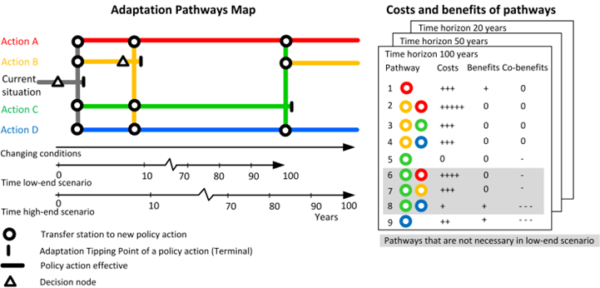
A schematic example of Adaptive Pathways planning, one example of how to frame decisions under conditions of deep uncertainty. Photo: John H Matthews via: An example of an Adaptation Pathways diagram and a scorecard for each... | Download Scientific Diagram
Moving beyond a risk mindset
As boards and business leaders grapple with the extraordinary complexities that mark the current context, stronger, bolder, more sophisticated risk management and scenario modelling tools have been at the vanguard of change. However, the emphasis on risk-led approaches to uncertainty brings dangers too — and can stifle the kinds of innovation and risk-taking that are at the heart of successful business. It remains equally important to keep a sharp eye on the potentially attractive opportunities that this rapidly-changing new context affords. Boards must therefore resist the natural tendency to focus excessively on risks at the expense of opportunities — despite this being the standard training for decision-makers.
Leading-edge approaches may not always come from the largest and most successful global businesses. Such incumbents may have the advantage of scale, but are often slowed down by institutional reliance on standardized practices and norms of governance developed during periods of relative stability and predictability. By contrast, institutions led by natural entrepreneurs are likely to fare better — with a cultural emphasis on innovation rather than managerialism, and an inherent ability to lead in the face of unknown futures. As such, corporations that are founder-led and controlled may find it easier than those with dispersed ownership to deal with this new world of deep uncertainty. Similarly, companies that have evolved in regions that have historically been characterized by volatile policy environments and erratic governance may have already developed the culture and practices that are vital to the years ahead.
All of these considerations raise an important question: what long-term frame of reference should guide decisions? What ought to be the company’s “True North”? It is here that a holistic approach to embedding risk, values and principles within the company’s culture and strategy is crucial. Rather than rigid prescriptions that may appear in a code of conduct, the path lies in principle-based foundations that are modelled by the board and leaders of the company, and shared across the entire company by communicating, authenticity and genuine engagement.
Purpose is not only a marketing strategy, but also a set of convictions that can be relied upon to guide actions and prioritize efforts in an uncertain world. IKEA’s longstanding commitment to renewables provides a good example — their efforts have not only reduced their emissions, but also insulated the organization and its customers from the ongoing impacts generated by the conflicts in the Strait of Hormuz.
Next steps for boards
The essence of enlightened governance, then, appears to begin with the open acknowledgment of the limits of what we know — and a willingness to explore what happens next. For many, this includes dynamic construction of multiple scenarios that allows for full consideration of the extreme uncertainty that marks the current context, accompanied by providing the space to reflect on the assumptions and values that should guide future planning. For many organizations, this also leads to a broader examination of the ways in which the priorities of individual organizations are bound in complex ways with a range of external stakeholders and societal factors. Creating the space for such considerations to emerge drives the development of a suitably broad range of strategic hypotheses that enable both resilience and opportunity.
This school of thought is nascent, and mistakes will be made, but boards cannot afford to sit still while tools and techniques are perfected, otherwise their companies risk being left behind. This means acknowledging openly what we do not know, keeping an open, exploratory mind and championing a willingness to test new processes in an experimental, iterative way. It also requires clearly articulated — and lived — long-term foundations based on values and principles, along with a balanced approach to risks and opportunities as central elements of fiduciary responsibility. It requires a commitment to a broad range of knowledge, agility, adaptability, greater proactivity (and less reactivity), and access to the widest possible diversity of worldviews and behaviors. Uncertainty is something humans often seek to avoid, but stepping into the unknown is also an act that has generated some of society’s greatest achievements. Our current moment of uncertainty is not only a disruption; but also an invitation to lay the foundations of something better.
This article has been written collaboratively by:
Karina Litvack: founding chairman and ambassador of the Chapter Zero Alliance; Non-Executive Director: Italian energy provider A2A S.p.A.
Roberto Waack - Non-Executive Director of Marfrig; Wise Plásticos SA; Instituto Arapyaú; and others.
Ashok Gupta - Founder of New Capital Consensus; Non-Executive Director of Sun Life; Mercer.
David Gunn - Senior Research Fellow, Sustainability Accelerator.